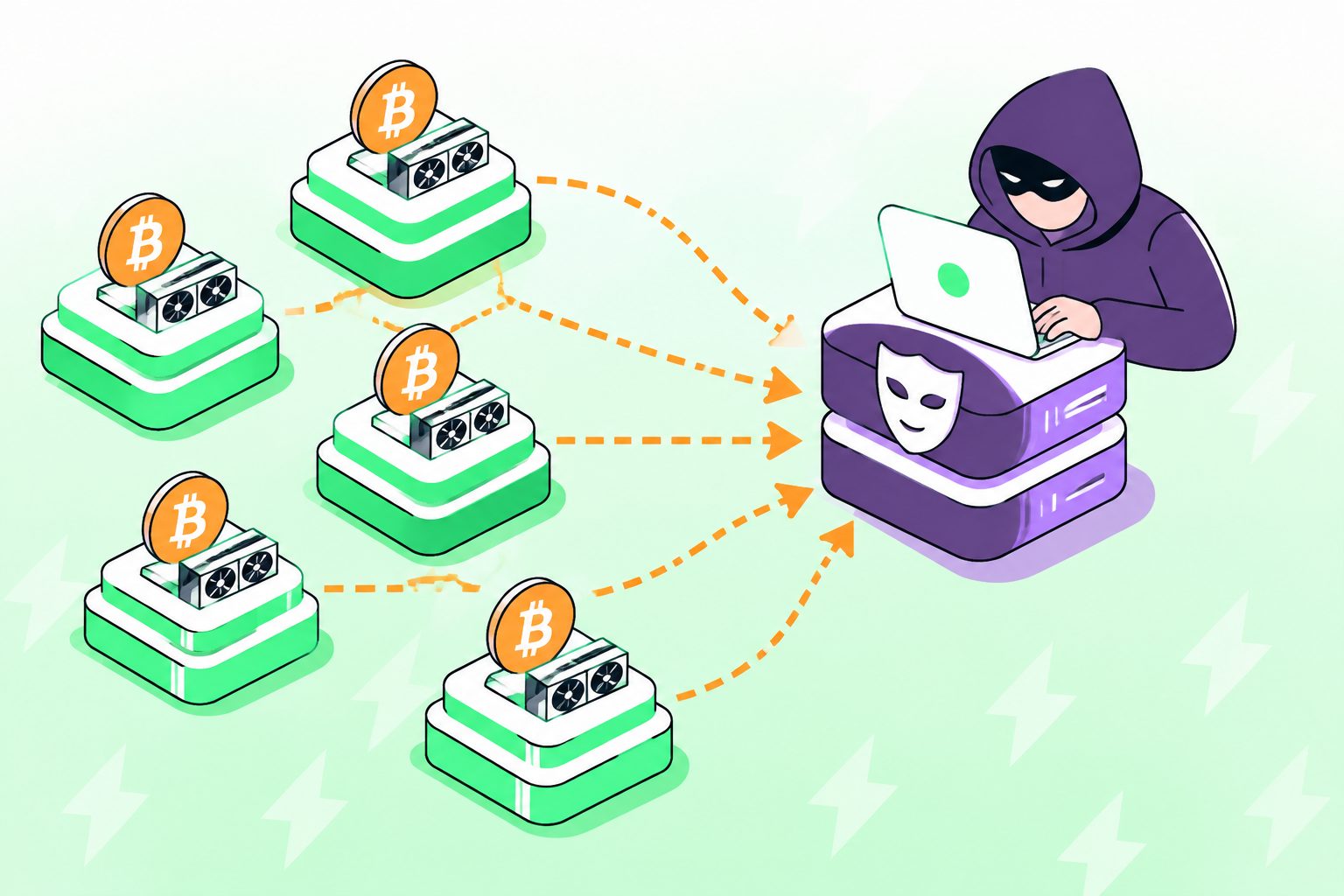
Braiins said attackers used forged internet routes to redirect mining sites to an impostor server on Nov. 20. The miners appeared to work normally, but their computing power was diverted. Braiins said its own systems, pool accounts, balances and payouts were unaffected.
Braiins recorded 19 earlier episodes from Nov. 7 to 12, concentrated in Brazil and Argentina, each diverting 36–174 PH/s. Four more, mostly in Europe, diverted 0.6–1.9 EH/s apiece and affected 1,050–1,600 sites each. Braiins called the Nov. 20 events brief and said, “We interpret this as testing the waters.” It said the attacks were still active on Nov. 25.
The attackers advertised a 256-address slice of a pool provider’s 4,096-address block using the Border Gateway Protocol (BGP). Networks favored the narrower route, sending miners reconnecting to the same IP address to the attacker’s server.
Stratum V1, used by many miners, transmits data without encryption or server authentication. A recording from a Brazilian miner on Nov. 16 showed an impostor server accepting any login and forwarding genuine jobs from another large public pool; the work was credited to the attacker’s account, while the miner’s dashboard showed zero. Braiins had warned about this risk in 2020 and found on Nov. 23 that most large pools still offered only unencrypted Stratum V1 connections.
Braiins tested seven firmware implementations on Nov. 20 and 23. Braiins OS 26.11 rejected every invalid certificate, while two other widely used implementations supported TLS but accepted invalid certificates. Braiins wrote, “TLS without verification gives the miner an encrypted connection to the thief.” The company released the tested firmware and a free proxy for older machines, which enables Stratum V2 connections for encrypted traffic and pool verification.
Networks enforcing RPKI route validation rejected the forged route. Braiins said a similar technique was documented in a 2014 Dell SecureWorks probe; its operator reportedly collected about $83,000 in Bitcoin and other proof-of-work mining payouts over four months.