



The universe of decentralized finance continues to expand year after year, touching more and more familiar aspects of our lives. Cryptocurrency has long ceased to be just a trend.
These days, decentralized finance lets you earn and experiment.
One of the most important tools for working with cryptocurrency is a crypto wallet. Read the detailed article about how crypto wallets work and how they're structured, to understand everything!
In this article we will take a detailed look at DeFi crypto wallets. After reading this material, you will learn how such services work, what they essentially are and, most importantly, whether this solution is suitable for storing your crypto or whether you would be better off choosing something else.
What is DeFi and why the wallet plays a key role
First, it's worth getting a general understanding of what DeFi actually is. Without complex technical jargon, the term encompasses all financial services and instruments that operate according to strictly defined rules provided by the developers.
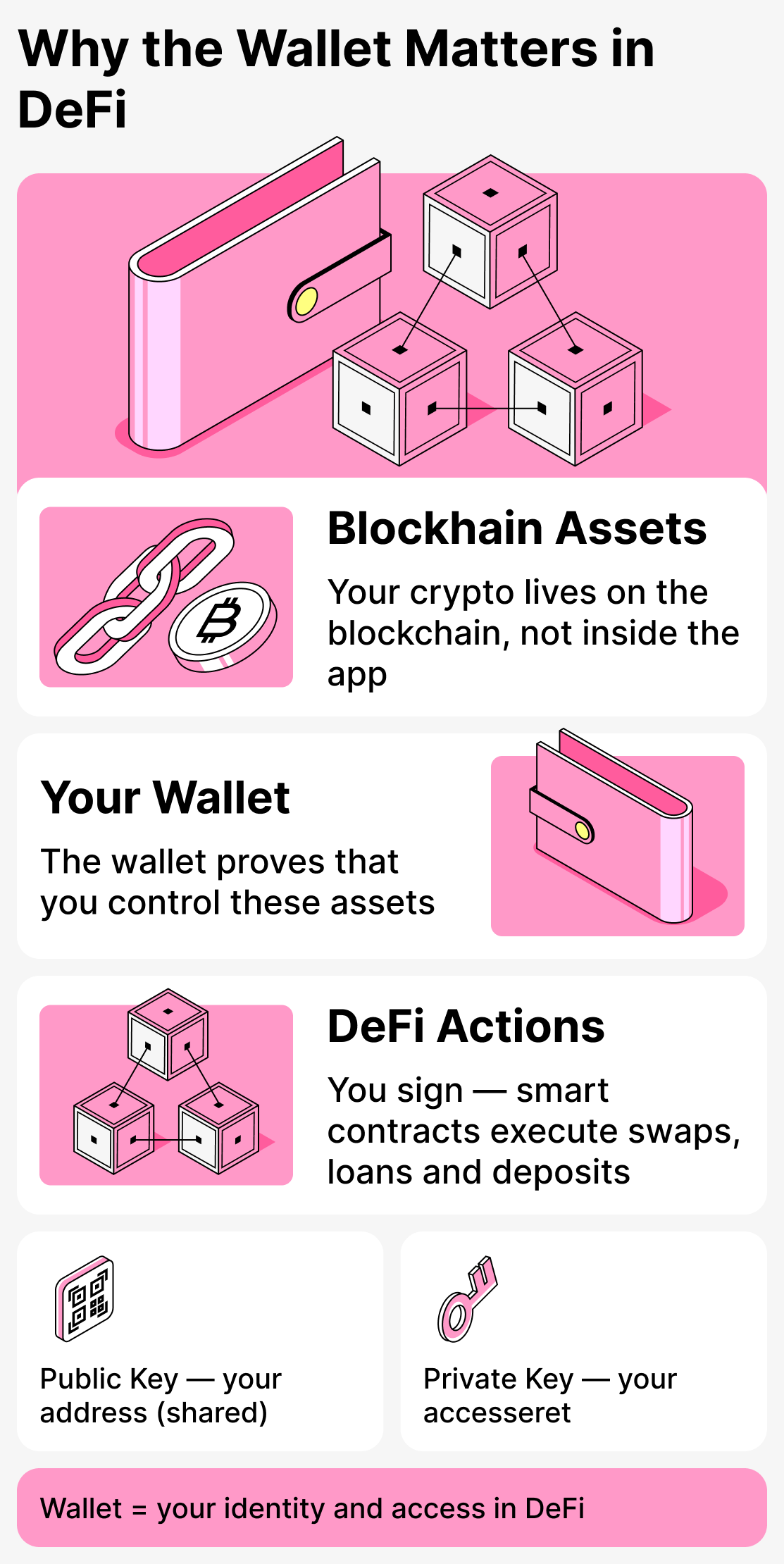
“Heart” or “brains” of DeFi services — program code or smart contracts (as it's called in the crypto industry).
In other words, when you use such a service you don't need to contact anyone, request confirmations from centralized operators, and so on. You simply follow the system's instructions, and if you do everything correctly — you immediately receive the result (the action encoded in the smart contract is executed).
A DeFi crypto wallet becomes your “representative” in the world of decentralized finance. It doesn't store your funds “inside”; instead it proves that you own a certain amount of cryptocurrency that is recorded on the blockchain. In the DeFi ecosystem you interact using the public and private keys stored in your wallet. These are the keys you manage.
How a DeFi wallet works: a simple explanation
Most popular DeFi wallets follow the principle of “self-custody” or “self-storage”. This means the private key that gives access to your funds is stored only with you. Neither the company providing the service, nor technical support, nor the exchange you use will be able to help you recover it if you lose it!
Therefore, when you create a DeFi wallet, a special seed phrase is generated along with it. It is a set of 12–24 words that serves as a kind of "skeleton" of your key. You must store it securely! Under no circumstances should you photograph it or send it online! Whoever controls the seed phrase controls the assets.
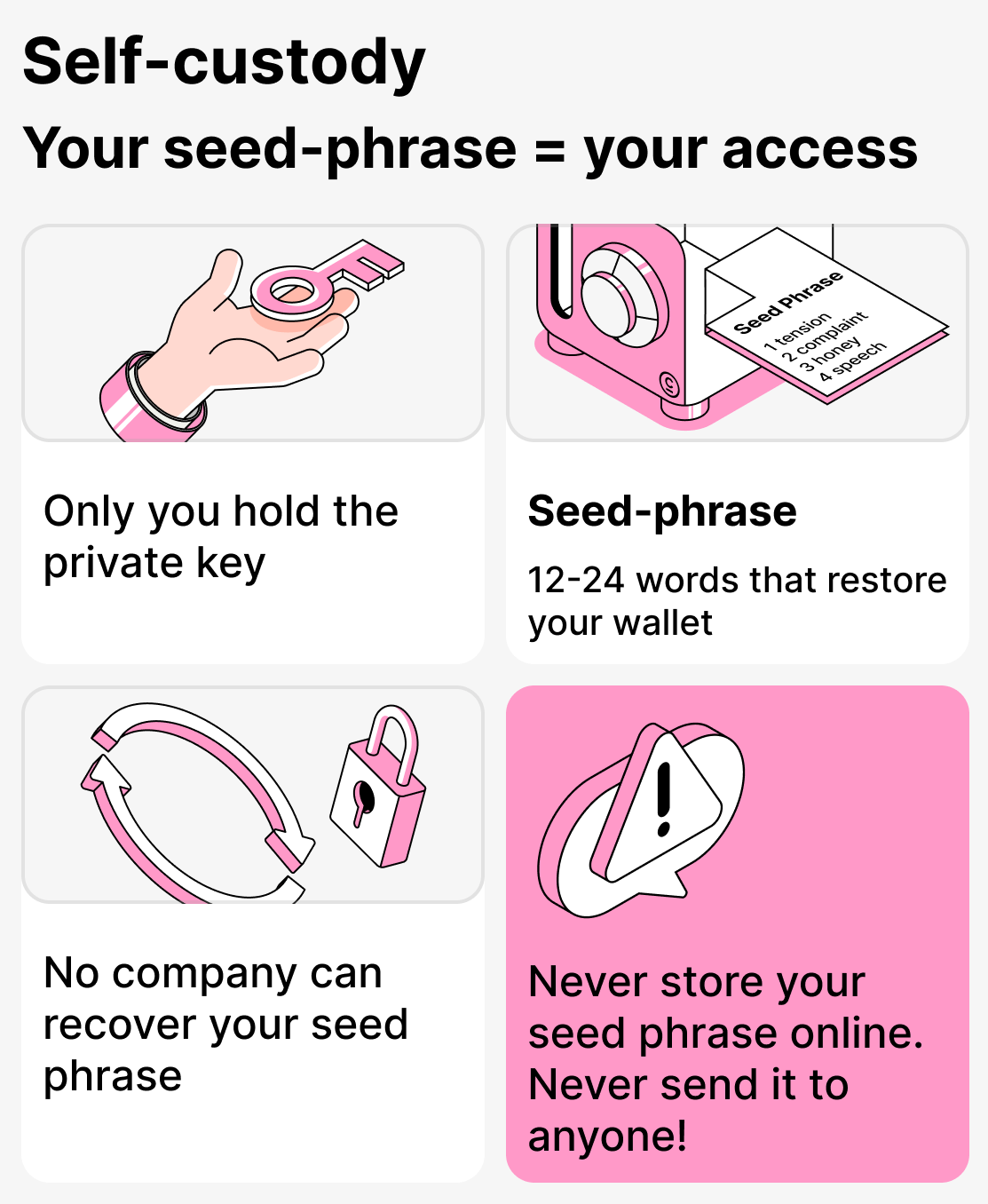
This principle gives users enormous freedom. With DeFi wallets, you can interact with any protocol, sometimes participate in new projects in the first minutes after their launch, and freely move assets between networks and services. However, where there is great freedom — there is great responsibility. Because DeFi wallets rely on automated protocols, any mistake when sending funds or the loss of your seed phrase will result in the loss of coins.
What you can do through a DeFi wallet: main functions and capabilities
In general, all crypto wallets allow you to store, send, and receive funds. DeFi wallets are no exception.
The defining feature of DeFi is that when you perform any operation, you interact with a well-defined algorithm based on smart contracts.
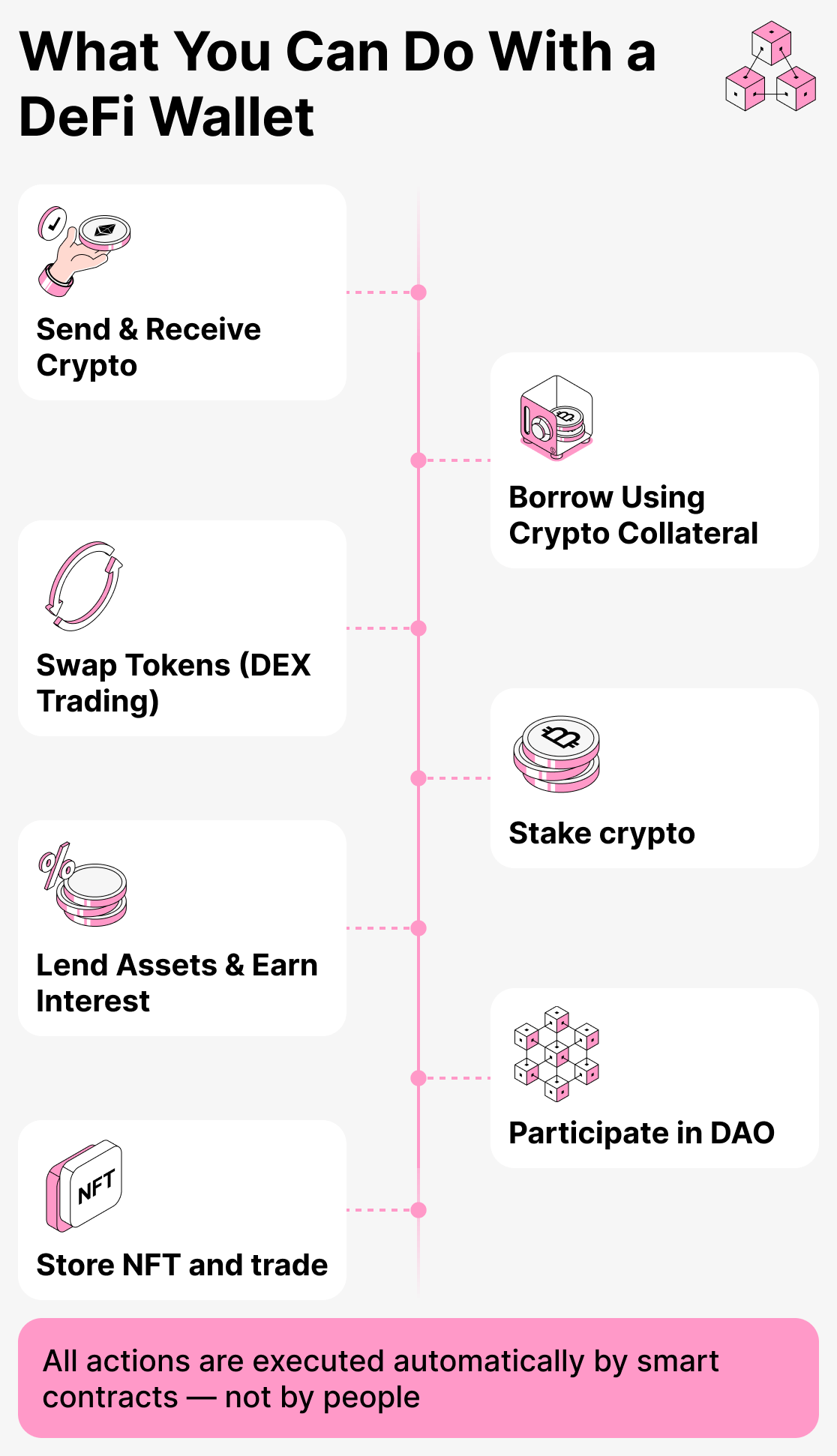
It's worth mentioning other actions you can perform with DeFi wallets. Each service has its own list, but overall most solutions offer the following additional features:
- Depositing funds into lending protocols and earning interest. It's a popular way to earn passive income.
- Obtaining loans secured by cryptocurrency through specialized protocols. This feature is currently extremely popular.
- Participation in staking. It's another common tool for generating income.
- Storing NFTs and interacting with them. Some DeFi wallets let you hold not only cryptocurrency in its pure form but also NFTs (various digital items that possess a unique digital identity). And, naturally, they can not only be stored but also sold.
- Participation in DAO( Decentralized Autonomous Organization) voting and in project governance. Many modern crypto projects do not operate like traditional companies where decisions are made by management. Instead, they are organized as decentralized autonomous organizations. Some DeFi crypto wallets can connect to such projects and participate in key votes on the future of an entire company or a “favorite” token.
All of the above functions are executed automatically. This is a distinguishing feature of DeFi and the smart contracts that such wallets rely on.
Risks of DeFi wallets: what every user should know
When a new user installs a DeFi wallet for the first time, they quickly realize: there is no comprehensive support or protection.
For example, when working with CeFi services, you are often asked to double-check all the details. Here you may encounter additional verifications, or you may even be contacted by a real specialist offering their help. This can irritate some users, since people often want to get everything done quickly. But newcomers, like pros, often forget why all of this is done. It's all for your safety!
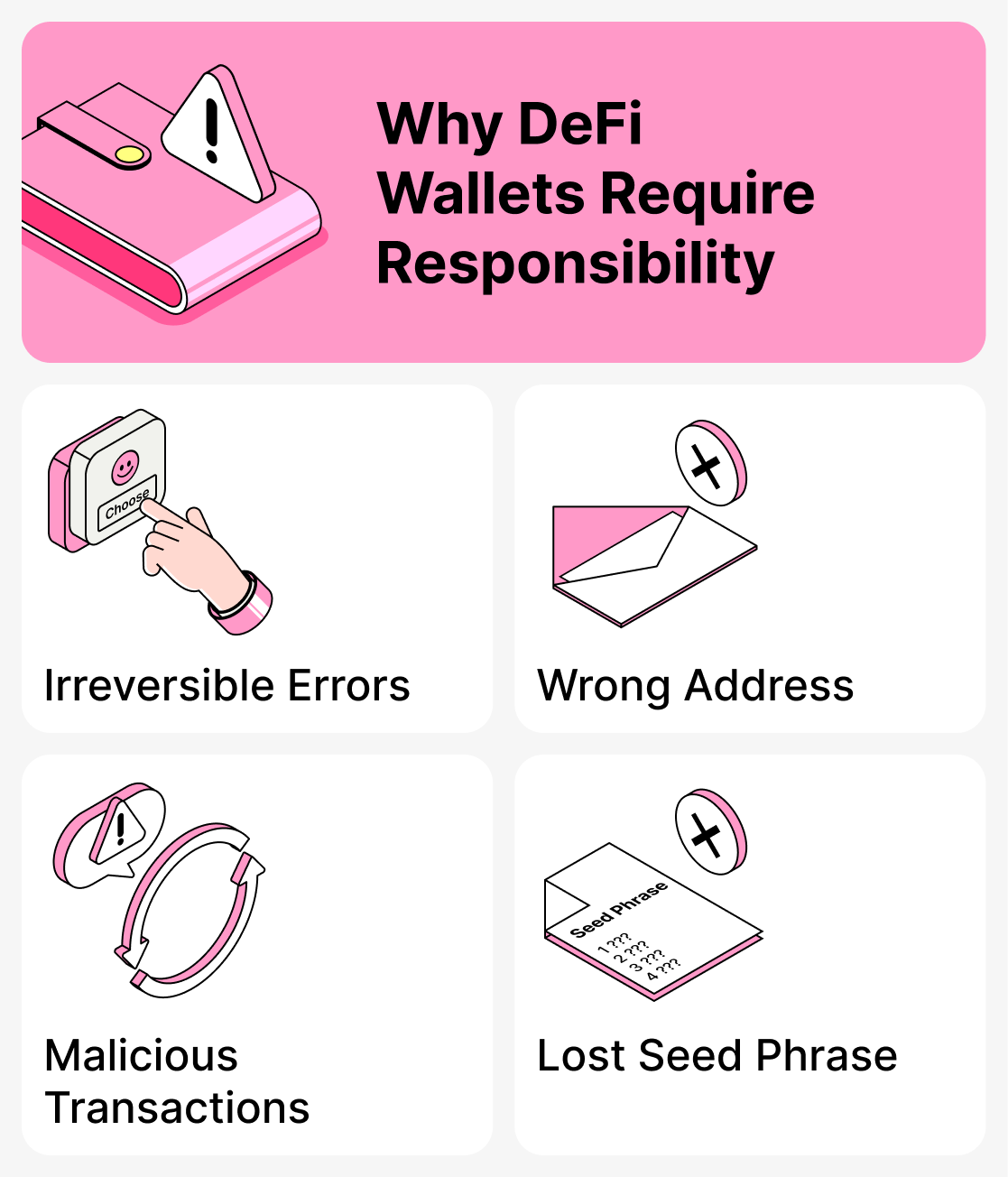
You won't find any of the above in DeFi crypto wallets:
- If you made a mistake or sent funds to the wrong recipient — the funds cannot be recovered;
- You signed an unfamiliar transaction — a malicious actor gained access to the wallet;
- Lose your seed phrase — lose access to your entire portfolio.
It's also important to note another nuance: DeFi wallets are generally not easy to master. You may encounter a complex interface and many features that take time to learn.
Why a simpler, safer option suits many users
A DeFi wallet is, in fact, a powerful tool for working with cryptocurrency, but it won't be suitable for everyone!
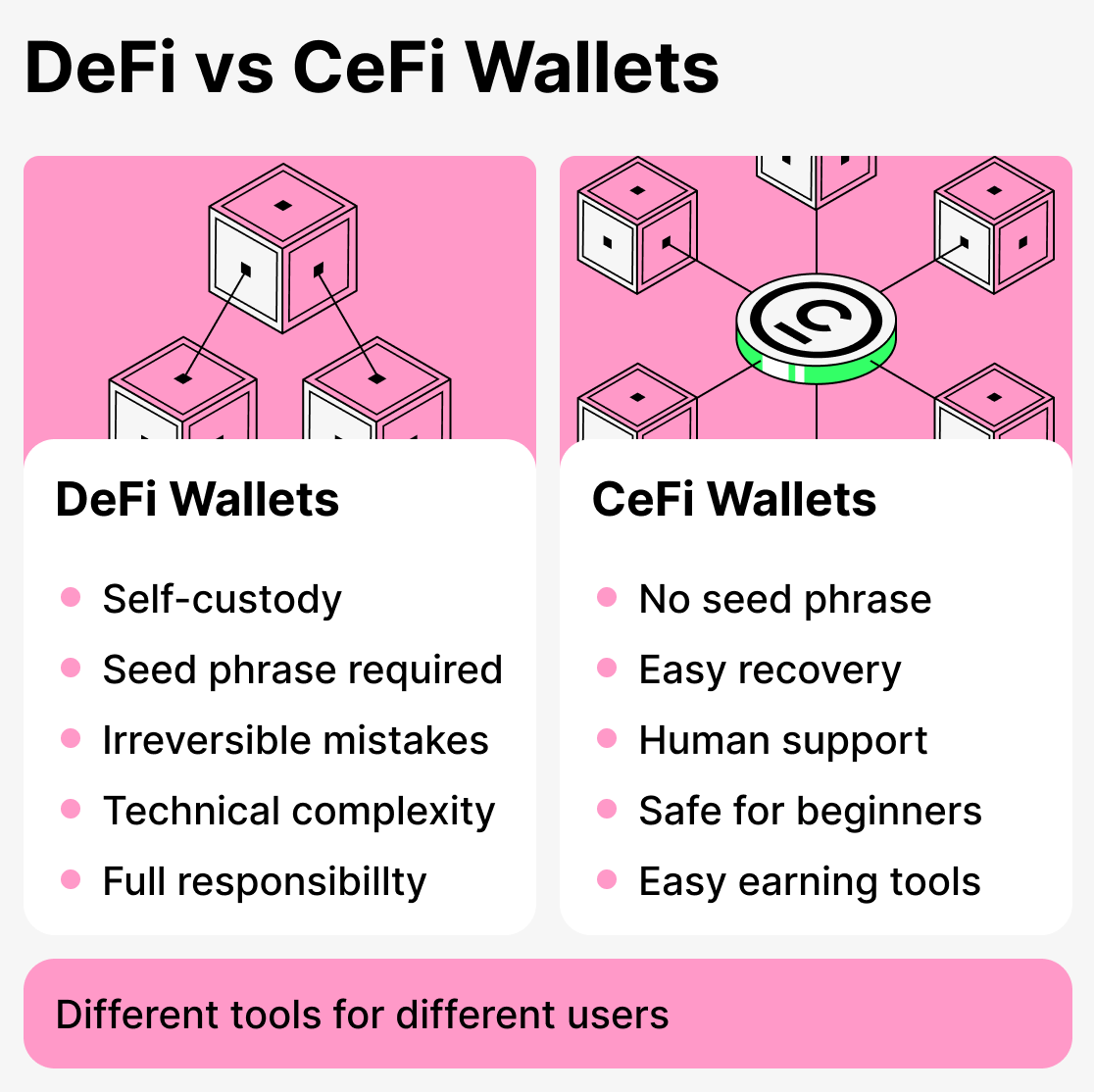
A DeFi service will be an excellent solution for those who already understand cryptocurrency well and prioritize the maximum freedom to act. However, such users will have to take responsibility for their own security!
For the general audience, and especially for those who are just beginning their journey into the world of cryptocurrencies, DeFi wallets can be too complex and unsafe for unprepared users.
If you want to store, send, and receive cryptocurrency, take out loans, and earn, but don't want to dive into complex technical details or be responsible for keeping your funds safe — you may want to consider CeFi crypto wallets.
One of the CeFi solutions is Cropty Wallet.
This is a custodial wallet with customer support staffed by live specialists. In addition, the developers themselves are responsible for safeguarding your funds and ensuring your security!
Every Cropty Wallet user can:
- Use all the main features of the crypto wallet;
- Get professional help;
- Restore access by email or phone number;
- Take crypto loans;
- Deposit funds and earn interest.
You won't need to memorize the seed phrase or worry about how to store it; the entire recovery process is as simple as possible. In addition, Cropty Wallet is available on all devices and also has a web version. The interface is user-friendly and intuitive, which beginners will especially appreciate.
Cropty Wallet offers an alternative path for those who want to use cryptocurrency without constant tension and the fear of making a mistake.
Essentially, DeFi wallets and CeFi solutions (Cropty Wallet in particular) are two sides of the same coin. It's like driving a car yourself or using the services of a professional driver: both ways of getting around are valid, but suit different people and different situations.
How to choose between a DeFi and a CeFi wallet: recommendations for different levels of experience
If you are well-versed in decentralized finance, ready to explore specific solutions, value maximum control, and willing to take full responsibility — a DeFi wallet will be the right tool for storing and managing your cryptocurrency.
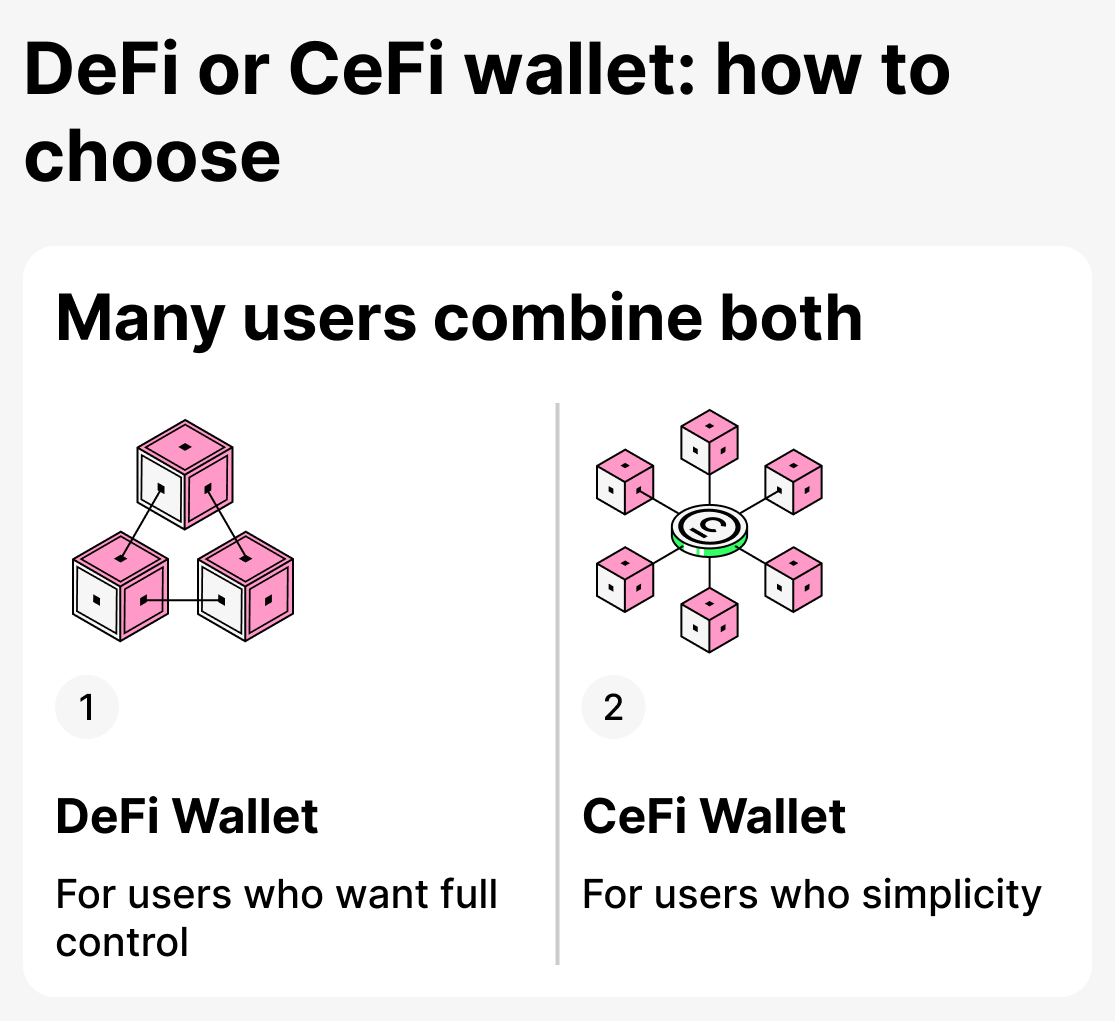
If you want to use cryptocurrency comfortably — CeFi wallets (Cropty Wallet as an option) will suit you perfectly.
Many people use both DeFi and CeFi wallets. The former are often used in various experiments, while CeFi wallets are used for everyday tasks.
Summary: Which crypto wallet to choose — DeFi or CeFi
So, we've covered how a DeFi crypto wallet works and examined its key features. But who is this kind of asset storage solution suitable for?
DeFi wallet — your gateway to the world of decentralized finance. It opens up many opportunities for users but requires a high degree of discipline, attentiveness, and an understanding of how blockchain works. It’s an excellent solution for those who want to manage their assets independently.
Cropty Wallet — an option for those who want to use cryptocurrency without unnecessary stress. The wallet offers a user-friendly interface, takes care of key management, ensures security, and provides more approachable solutions.
Choose what suits you best based on your personal experience, goals, and needs.