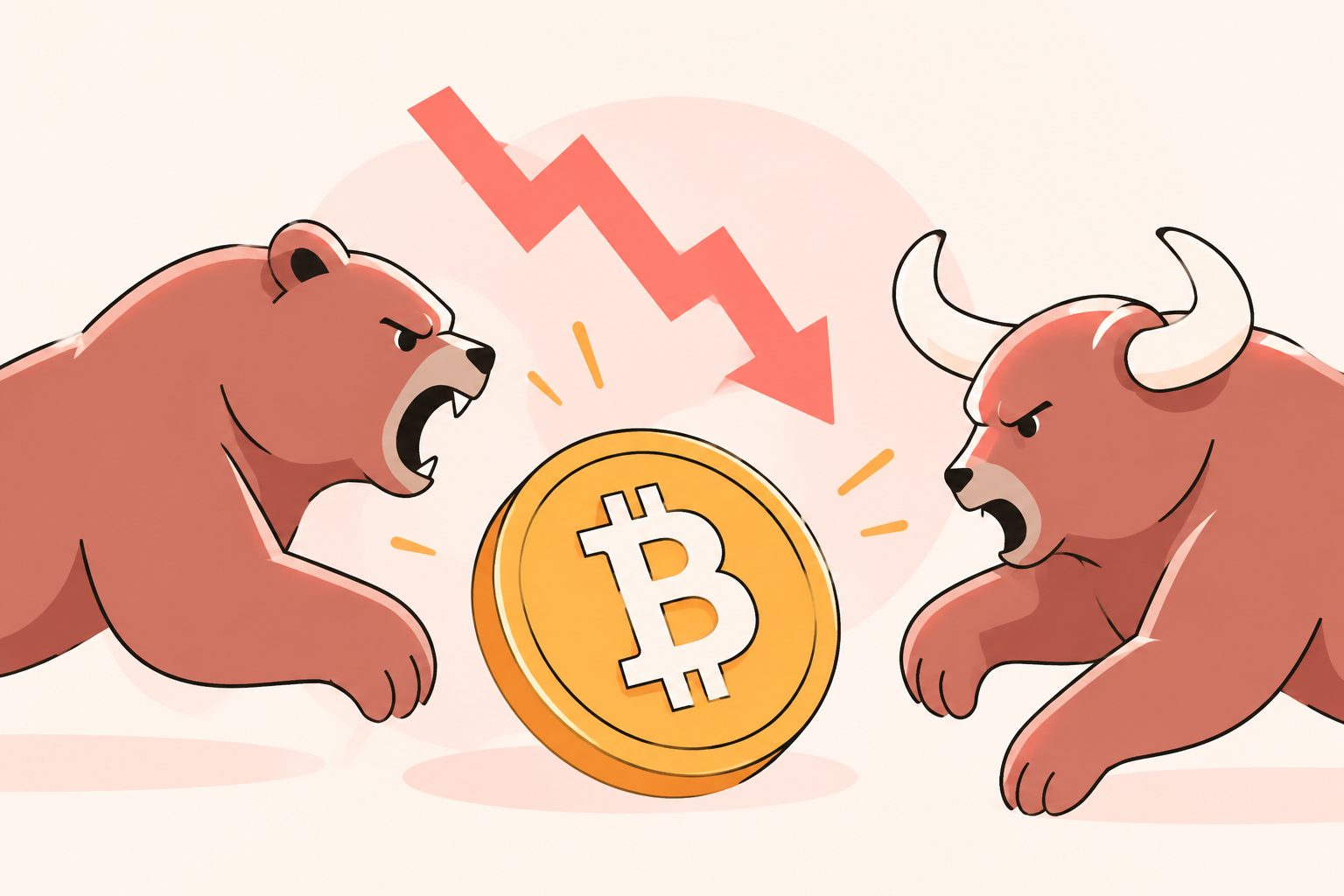
Galaxy Research withdrew its June bottom call after Bitcoin closed below its 50-week average. Its bear-case trigger—a daily close below $58,525, the June 30 low—has not been reached, despite three intraday dips beneath that level from Nov. 20 to 26.
Galaxy’s October call followed Bitcoin’s Sept. 20 weekly close at $81,195, above its 50-week average of $78,787 and ending 44 consecutive weekly closes below the average. Of 14 historical reclaims, 11 of the 13 before this year saw the low at the time hold until the next record high. The two exceptions, in December 2021 and March 2022, lost their lows within two weeks. This year’s reclaim lasted seven weekly closes; the week ended Nov. 8 closed 0.7% below the 50-week average, and the next week ended at $65,189, 4.1% below the 200-week average. Galaxy retained its arguments on positioning, fundamentals and sentiment.
Galaxy defines a break as a daily close below $58,525, using 00:00 UTC closes. Bitcoin’s lowest weekly close, $59,517, is a separate level the firm wants to see hold. On Nov. 21, BTC fell almost 6% below the daily threshold intraday but closed 2.7% above it. On Nov. 20, it finished just $290 above the line; on Nov. 22, its intraday low stayed $111 above it. Galaxy CEO Mike Novogratz bought 415,000 Galaxy Class A shares on Nov. 20 for about $4.87 million, at weighted average prices near $11.73 and $12.32, according to an SEC filing. The shares are held through an entity he controls. Galaxy also operates the Helios data-center business.
Galaxy’s comparison counts “standing lows”: bear-market closing lows that held for at least 60 days and were followed by a rebound of at least 20%. Its seven completed cases span 2014, 2018 and 2022; the number remains seven with a 25% rebound requirement. After those breaks, the smallest further decline to the eventual closing low was 17.1%, and the median was 51.8%. From $58,525, those would equate to about $48,500 and $28,200. Galaxy calls them historical reference points, not targets: “We are not trying to call the low.” It identifies $48,400–$53,200 as the nearest support cluster and $29,100–$46,100 as the range where earlier bear markets ended. The 17.1% figure is not a guaranteed floor: a July 2013 break excluded by Galaxy’s cycle definition ended 2.8% lower, and a new break now would occur later in the cycle than any of its seven cases.
Galaxy attributed a roughly 2.9-percentage-point jump in the share of BTC untouched for at least a year on Nov. 22 to an exchange moving about 580,000 BTC to new addresses it controlled exactly a year earlier. Such transfers reset coin age. The firm said those coins were not behind recent selling and cautioned that rising dormancy does not show that selling has ended; coins held for one to five years have been moving more. On Nov. 26, Bitcoin closed at $60,496 on Coinbase, $979 above the June weekly low and $7,663 below its 200-week average.