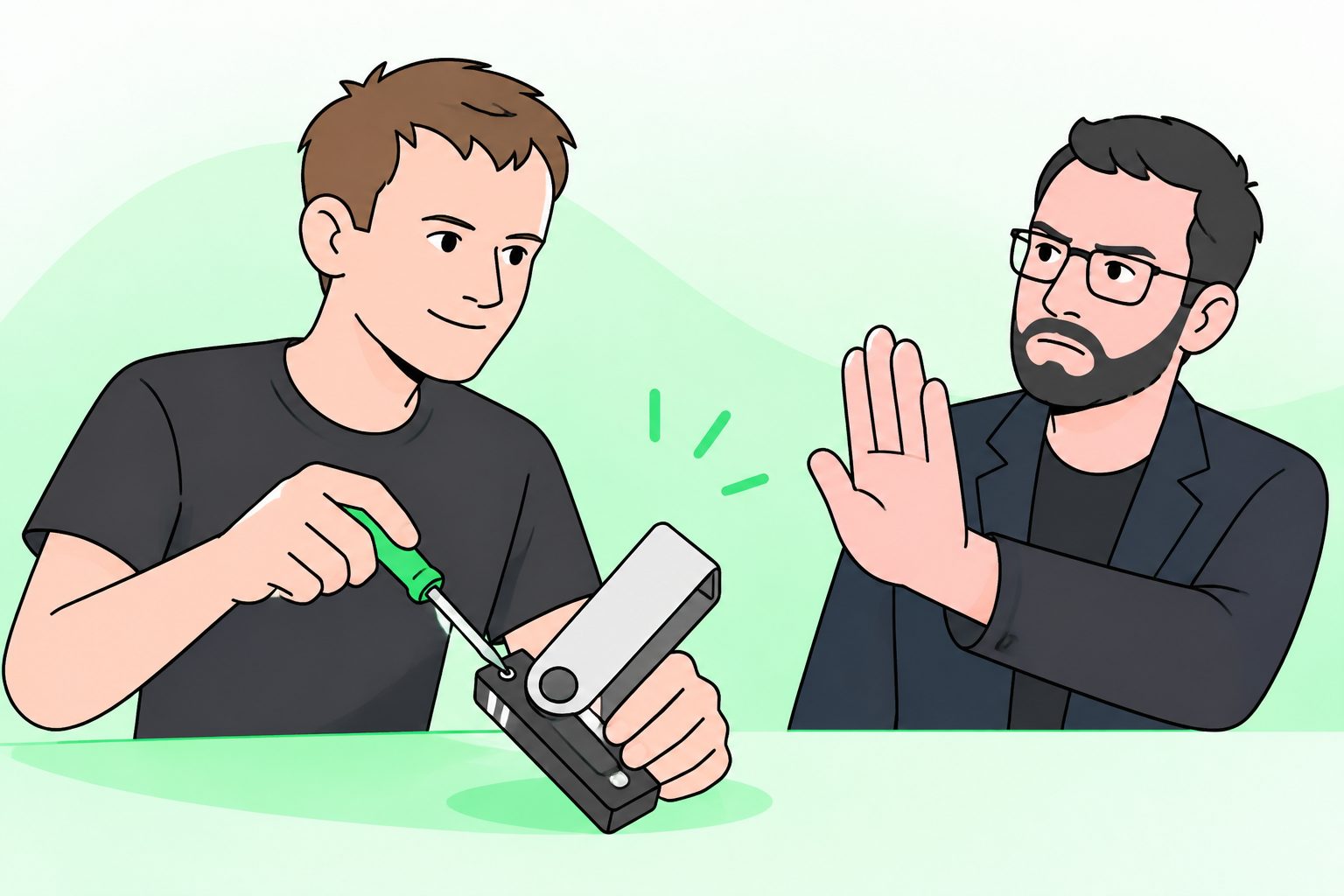
Ethereum co-founder Vitalik Buterin says hardware wallets need protection against chips tampered with during manufacturing. His proposal calls for secure hardware designs to be open and inspectable down to factory drawings, though it would not remove the need to trust manufacturers.
In a Nov. 26 post, Buterin summed up the risk: “Not your silicon, not your keys.” He argued that auditors, journalists and civil society groups could inspect manufacturers and distributors. Infrared photographs can reveal some tampering, but subtler changes may require dismantling a chip layer by layer, destroying it; only samples could be examined this way. He also called for chips to be designed to be “more inspection-friendly.”
Buterin said, “In order for computation to be democratized, the hardware layer must be open for participation and tinkering too. In order for computation to be secure, the hardware layer must be open and inspectable,” and predicted a split between “performance hardware” and “secure hardware.” Secure chips could be “10x less efficient” or more, he said, while remaining efficient enough for most uses.
Ledger CTO Charles Guillemet, who is leaving the company at year-end, disputes that publishing chip designs guarantees the hardware matches them. In August, he said, “You might think: ‘Then build an open-source secure element.’ That sounds elegant. It is mostly wishful thinking,” adding that “many eyes” reviewing code do not guarantee security. Coinkite has said the randomness bug behind the Coldcard incident remained in public code for more than five years and escaped at least 15 independent security reviews. Guillemet said, “Anyone who has done offensive security knows this,” arguing that closed designs make exploitation harder.
Hardware hacker Andrew “bunnie” Huang’s infrared inspection work informs Buterin’s proposal. Huang has said the industry prioritizes “anti-tamper measures take priority over inspectability.” Ledger’s approach chiefly aims to protect devices from people who obtain them; Buterin’s focuses on risks from manufacturers.
Some products already mix approaches. Trezor Safe 7 combines a certified, closed Infineon OPTIGA chip, the open-design TROPIC01 chip made by its sister company Tropic Square, and a main microcontroller. Trezor says the seed is not stored in either secure chip; it is encrypted on the microcontroller using keys from both chips.
In a lab test this year, Ledger’s Donjon team used a laser to bypass TROPIC01’s firmware-signature check and run its own code. Trezor says the researchers extracted a subset of protected secrets, and that the published code revealed how the check worked. Trezor says the flaw was disclosed, a fix for future chips is being developed, and the layered design means the flaw alone cannot expose users’ PINs or funds.
The incidents cited this year involved other weaknesses: Coldcard’s seed-generation issue stemmed from a firmware bug, while implants found in Ledger devices and, on a smaller scale, Trezor devices were extra parts placed inside the cases. Buterin’s proposal targets a possible future threat—chips swapped for look-alikes. In 2023, Huang suggested inspecting a chip first, then sealing it in opaque epoxy if protection from later tampering is needed. Whether users can ever avoid trusting anyone remains unresolved.