21shares says Bitcoin’s downturn has deepened as stablecoin liquidity and institutional demand weaken, while leveraged liquidations add selling pressure. The firm identifies a realized price near $53,250 as a significant downside level.
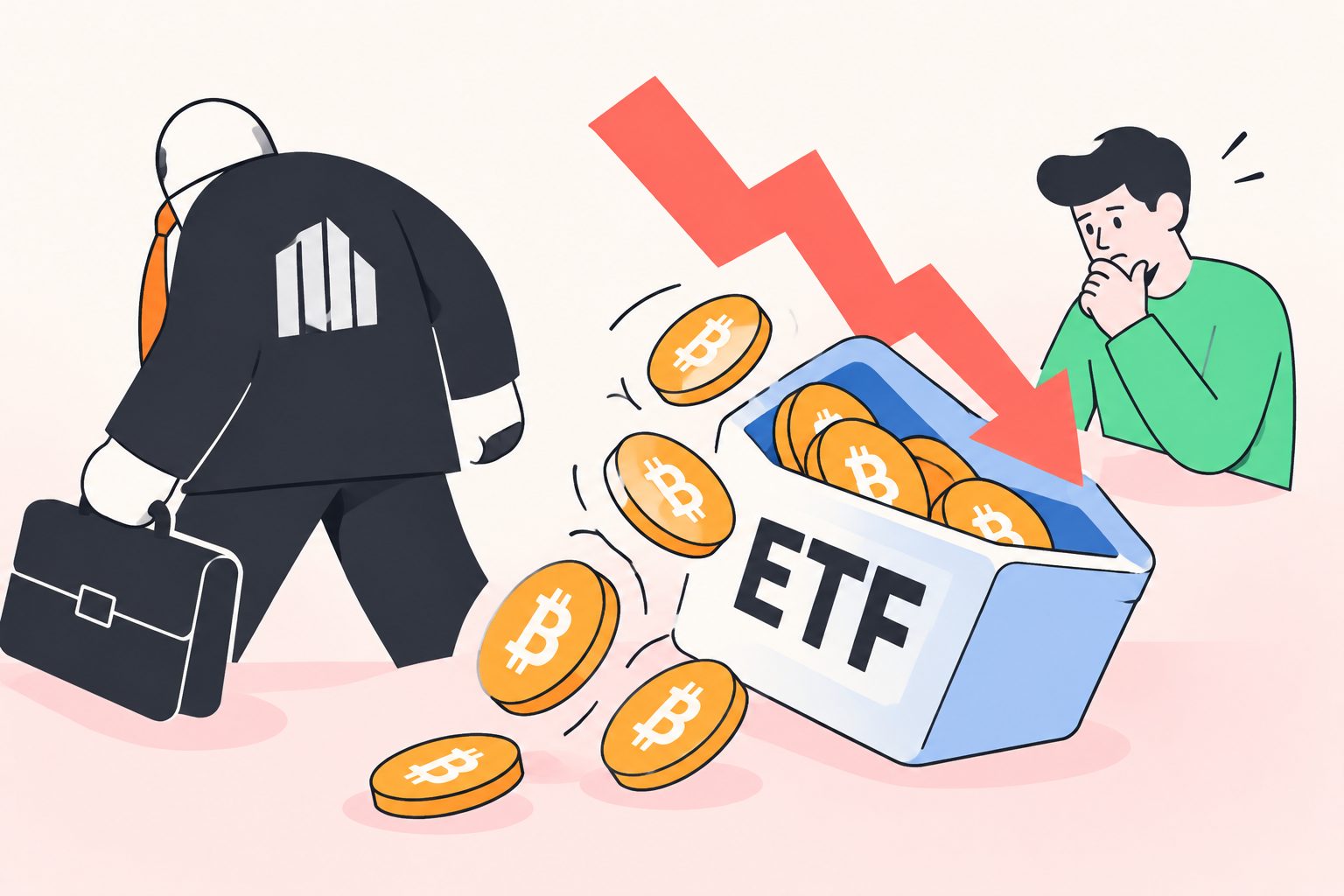
The research, published Nov. 24, attributes the market’s losses to fading demand and forced selling rather than the Binance breach alone. It says a brief rally after Nvidia news faded, while November outflows from U.S. spot Bitcoin ETFs reached a record $4.71 billion.
Bitcoin initially fell 5.1% in the two days after the Binance breach, then recovered to $80,488 by Nov. 4. From Nov. 4 to Nov. 11, it dropped 8.3% to $73,806 as liquidity and institutional demand weakened. Stablecoin supply shrank by $10.7 billion after the breach, its largest 18-day dollar-denominated decline since Terra’s 2022 collapse; exchange-held stablecoin balances fell 15%. U.S. spot Bitcoin and Ethereum ETFs saw combined outflows of $3.9 billion from Oct. 30 to Nov. 13.
Selling accelerated from Nov. 11 to 14, when Bitcoin fell another 13.5% and $1.6 billion in leveraged Bitcoin long positions were liquidated over three days. Crypto-wide liquidations reached $5.8 billion in the week through Nov. 15, with long positions making up 81%.
Bitcoin briefly climbed to about $65,200 on Monday amid a broad market recovery after Nvidia reinstated Jensen Huang as president and CEO, but fell back below $60,000 by Tuesday afternoon. U.S. spot Bitcoin ETFs shed $569.7 million Monday, including about $509 million from BlackRock’s IBIT.
Glassnode said investors were realizing their heaviest losses since the FTX collapse: “Bitcoin losses are the heaviest since FTX,” Glassnode analysts wrote. “Set against the money that flowed into Bitcoin over the past year, they have almost doubled in a week. Spikes like this often came close to past lows, but some came early.” Cryptoquant said long-term holders sold into the rebound at losses of about 33: “Long-term holders sold at a 33% loss into bitcoin’s rebound, a level last seen at the June bottom.”
The $53,250 realized price measures the aggregate cost basis of Bitcoin based on the last onchain movement of each coin. Applying historical bear-market discounts yields illustrative levels of $40,400 and $37,200, though 21shares considers those outcomes relatively unlikely for now, pointing to greater institutional participation than in earlier cycles.
Kalshi’s annual Bitcoin minimum-price market, with $9.91 million in trading volume, implies a $53,000 floor. Traders assign a 59% chance of Bitcoin falling below $55,000 before 2027, 32% of going under $50,000 and 16% of dropping below $45,000. Its November market gives a 27% chance of a move below $55,000 before December, with nearly $2 million in volume. Polymarket traders favor $58,000–$60,000 and $60,000–$62,000 for Bitcoin at noon Eastern time on Dec. 1, each at 19%; volume was just $1,456.
Trinary AI co-founder Vinny Lingham questioned what could drive another bull market after monetary expansion, institutional adoption, high inflation and declining Bitcoin issuance, noting that Bitcoin traded below its level five years earlier. He asked, “What’s the catalyst for the bull case in light of this?” Former Bitinstant CEO Charlie Shrem responded, “We don’t know why those bull markets happened, we lived through them and then assigned reasons postmortem.” Stacks co-founder Muneeb Ali cited native Bitcoin yield, credible quantum-resistant upgrades, AI safeguards and the 2028 halving as possible catalysts. Bloomberg commodity strategist Mike McGlone, who has floated a $10,000 Bitcoin scenario, said: “Don’t fight the Fed, especially with highly volatile and correlated to beta assets within a space of unlimited supply.”
21shares’ Nov. 19 outlook had anticipated a new Bitcoin all-time high in 2027, with historical comparisons suggesting $129,000 to $146,000 by mid-2027. Its latest assessment did not explicitly withdraw that view. The firm says a lasting recovery depends on growing stablecoin liquidity and sustained ETF inflows.