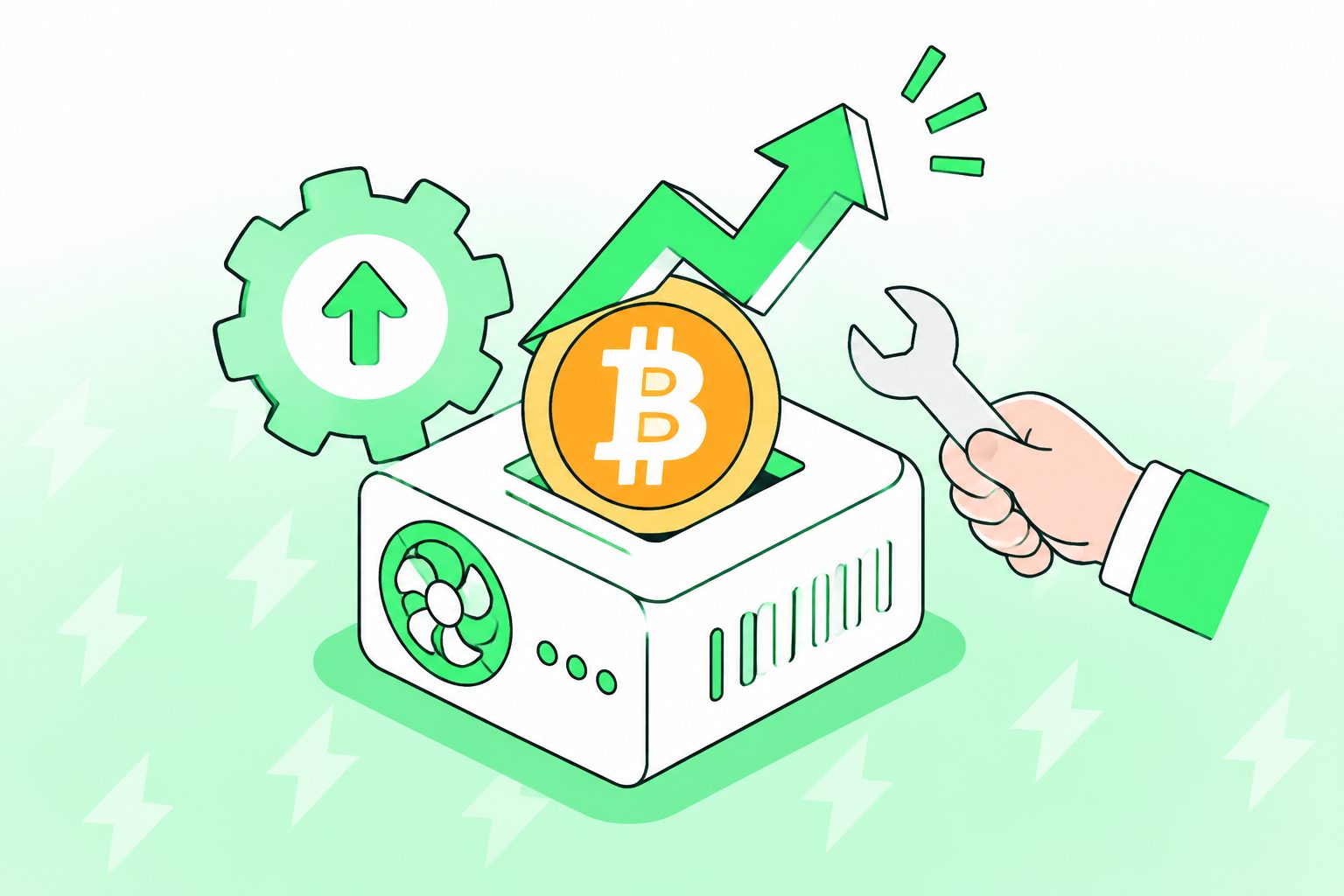
Bitcoin raised mining difficulty from 134.82 trillion to 145.09 trillion at block 977,760 on Nov. 27. The adjustment followed a faster-than-target block period and partly reversed the 9.13% reduction made on Nov. 14; difficulty remains about 2.21% below its earlier 148.36 trillion level.
The retarget responds to the time taken to mine the previous 2,016 blocks: when blocks arrive too quickly, the mining target shrinks and difficulty rises. Because block timing is variable, the 7.61% adjustment does not mean network hashrate increased by that exact amount, nor does it show when miners added equipment.
At the new difficulty, the same work is expected to produce about 92.9% of its previous output, a decline of roughly 7.08%. For example, an expected 1,000 sats from the block subsidy would become about 929, before pool fees and assuming other factors stay constant. An Avalon Q rated at 90 TH/s and 1,674 watts uses about 13.39 kWh over eight hours. At $0.15 per kWh, that costs around $2.01 in electricity. If an eight-hour run had earned $2.10 after pool fees before the change, the illustrative revenue would fall to about $1.95, turning a nine-cent margin after power into a six-cent loss. These are hypothetical figures, not a machine earnings quote.
In that example, the break-even electricity rate drops from about $0.157 to $0.146 per kWh. Actual profitability depends on measured power use, electricity prices, fees and uptime; Bitcoin’s price and transaction fees can also change independently, and pool payout methods vary. For a solar-powered miner, the relevant cost may be the credit forgone by not sending surplus power to the grid. Matching the old expected output would require about 37 extra minutes at the same speed—roughly another kWh for the Avalon Q.
The higher difficulty also lowers modeled solo-block odds. An Avalon Q running eight hours a day for a year goes from about 1 in 613 to 1 in 659; a 4.8 TH/s NerdQaxe++ Rev 7 goes from about 1 in 11,500 to 1 in 12,350. These estimates hold difficulty and hashrate steady, although difficulty changes over time, and a run of misses does not make a future block more likely. Solo CKPool logs show a miner averaging about 161 TH/s found block 975,427 on Nov. 11, receiving 3.1541 BTC before the pool fee. On Nov. 22, another miner with about 11.1 TH/s found block 977,057 after the difficulty cut. The next adjustment is due at block 979,776, but its calendar date remains an estimate until the network reaches that height.