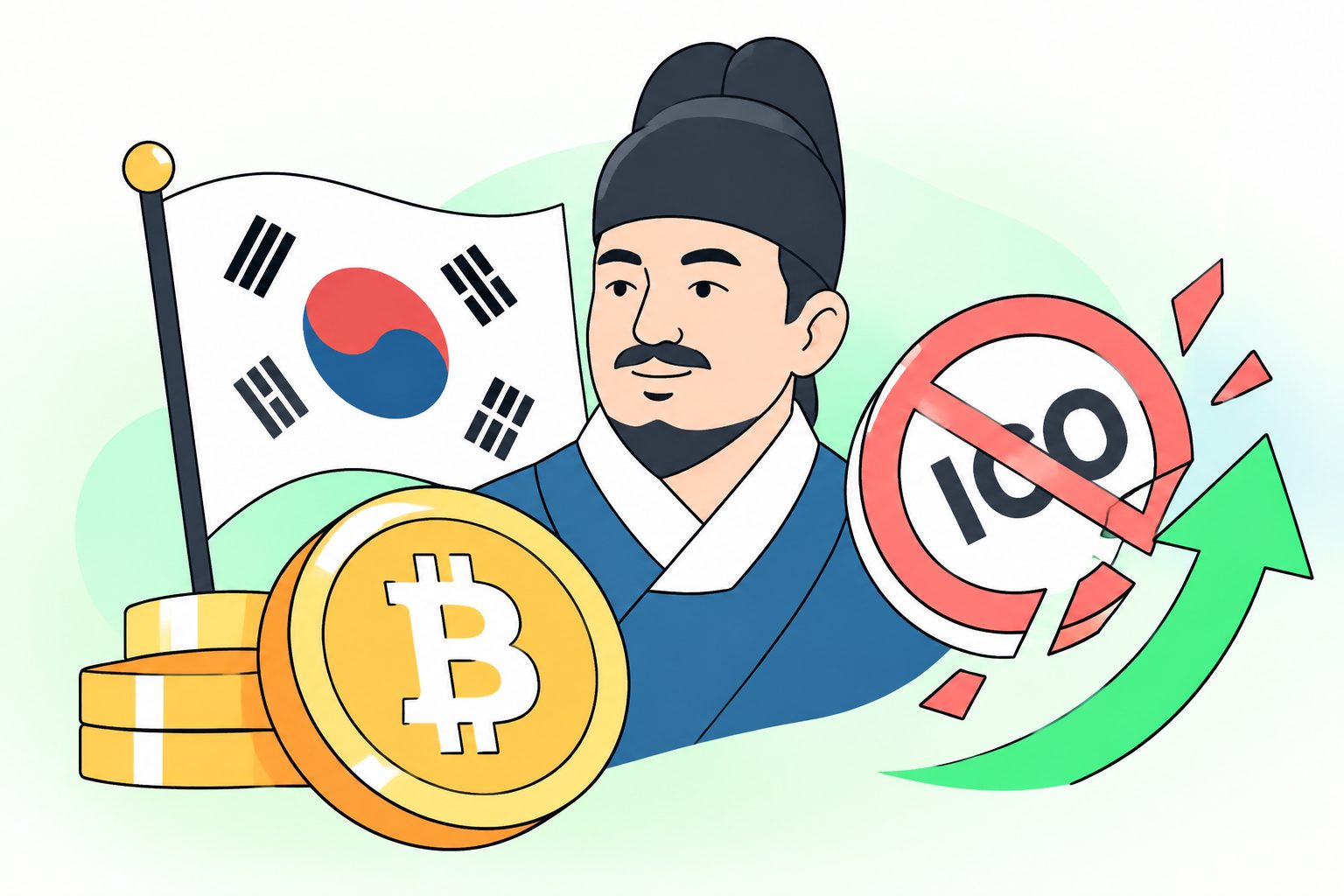
South Korea’s Financial Services Commission proposed reversing the country’s 2017 ban on initial coin offerings, allowing domestic token issuance and sales under a regulated framework. Issuers would have to disclose project details and risks, and could face civil, financial or criminal penalties for misleading statements or omissions.
The draft forms part of the broader Digital Asset Act and still needs approval from the National Assembly. Issuers would submit a white paper to the FSC identifying responsible parties, the use of proceeds, token supply, project specifications and investment risks, alongside a shorter prospectus for investors. Exchanges would have ongoing disclosure duties for significant developments affecting listed assets.
The proposal also calls for bank-majority ownership of won-denominated stablecoin issuers and a general 20% ownership cap for major exchange shareholders, with exceptions allowing stakes of up to 34%.
South Korea banned ICOs in September 2017 amid concerns about speculation, fraud and investor losses. The ban did not stop local participation: firms often set up overseas entities to raise funds, with Singapore and Hong Kong among their destinations. Projects linked to gaming companies Wemade, Netmarble and Com2us Holdings continued developing digital assets. The government says bringing fundraising home could retain capital and technical talent and support jobs in blockchain, fintech and digital asset services.
The ICO model involves selling newly created tokens to fund projects; token purchases do not necessarily grant ownership or other rights in a company. Mastercoin, later renamed Omni, raised about 4,700 BTC—roughly $500,000 at the time—in 2013. Ethereum raised about 31,500 BTC, then worth $18.4 million, in 2014, and the ERC-20 standard introduced in 2015 made token creation easier. ICO fundraising surged to about $6.9 billion in the first quarter of 2018, according to CB Insights data compiled by Statista. Block.one raised roughly $4 billion, Telegram raised $1.7 billion in private sales, and Tezos, Filecoin and Bancor each raised more than $150 million.
A 2018 Bloomberg and Satis Group analysis classified about 78% of the 2017 ICOs it examined as scams, though those projects represented a much smaller share of funds raised. China banned ICOs in September 2017, while U.S. regulators applied securities laws to token sales. Block.one agreed to a $24 million civil penalty in 2019 over an unregistered offering. Telegram agreed in 2020 to return $1.2 billion to investors and pay an $18.5 million penalty; outside developers continued work on what became The Open Network, which Telegram later embraced.
Token fundraising continued through exchange and decentralized exchange offerings, security token sales, airdrops, venture funding and meme-coin launchpads. Public token sales gained interest in 2025 amid criticism of venture-backed launches with small circulating supplies and high valuations. Monad received about $269 million in subscriptions, and Pump.fun raised $600 million in a public offering. But Cryptorank data shows public token fundraising fell from $849 million in the first quarter of 2025 to an estimated $40 million in the second quarter of 2026, a decline of about 95%.
The EU’s MiCA rules, fully applicable from December 2024, generally require eligible public token offerings to publish and notify regulators of white papers, with liability for misleading disclosures. The U.S. SEC proposed a framework on Aug. 18, 2026, including an exemption for up to $5 million in eligible fundraising over four years and another for offerings of up to $75 million annually; neither had been finalized. South Korea’s National Assembly considered lifting the ban in May 2018, but it remained in force.