
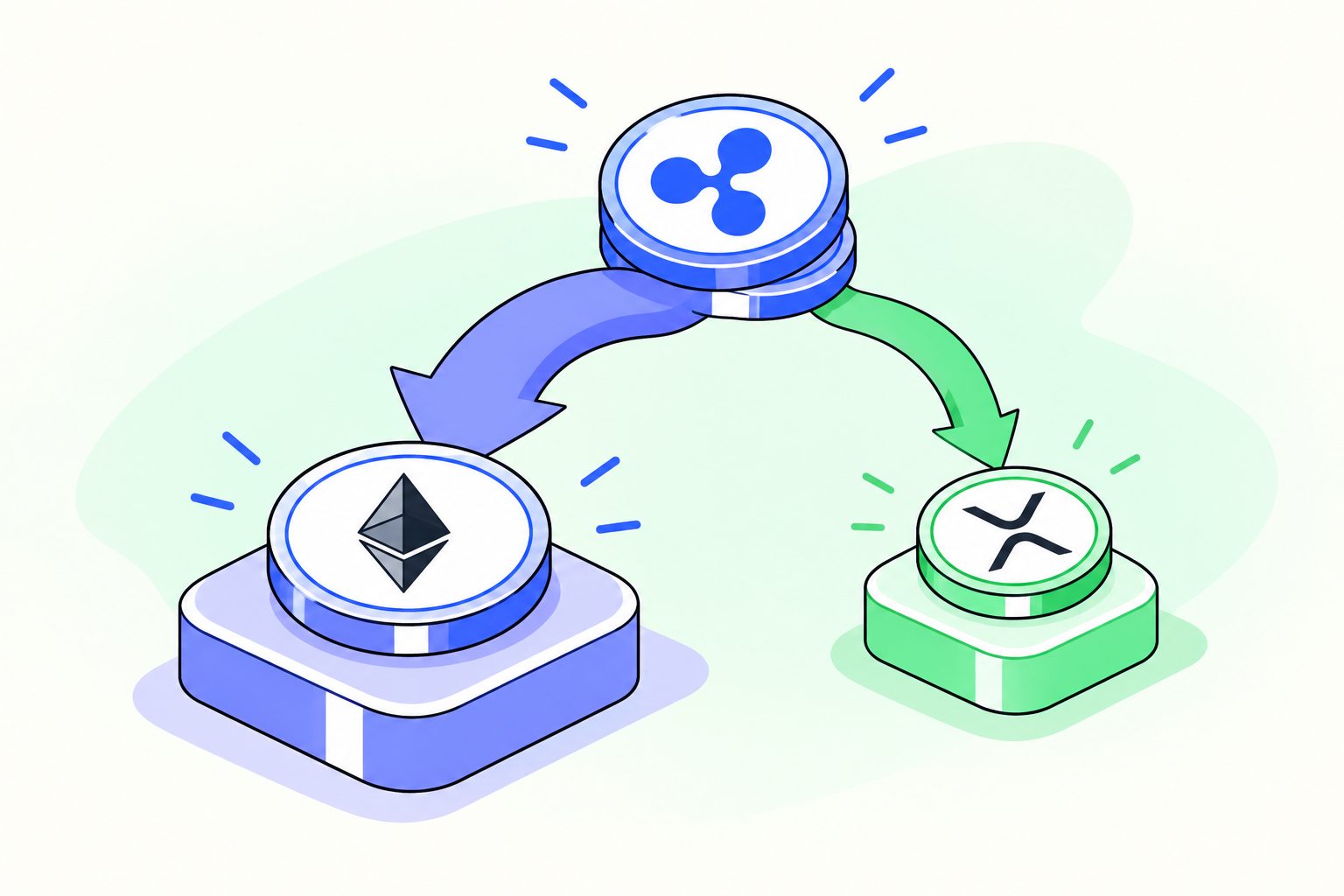
As of November 25, Ethereum hosted about $2.03 billion of RLUSD’s $2.81 billion supply, compared with $760.66 million on the XRP Ledger (XRPL). Ethereum’s larger DeFi and stablecoin markets give RLUSD access to more established lending and trading applications.
Ethereum’s lead over XRPL has grown from about $350 million in September to more than $1.26 billion. DefiLlama puts Ethereum DeFi’s total value locked at $36.15 billion and its stablecoin capitalization at $128.76 billion; XRPL has about $29.8 million in DeFi TVL and $849 million in stablecoins. Ethereum’s stablecoin market is roughly 152 times larger. Its ERC-20 standard also works with established wallets, exchanges and lending protocols. Aave’s Horizon market, for example, lets users borrow RLUSD against eligible tokenized real-world assets.
Ripple tested RLUSD on Ethereum and XRPL in August 2024 and launched it in December. The company has since expanded distribution through institutional partnerships, exchange integrations and cross-chain infrastructure. Ripple Mint, introduced in July 2026, lets institutions mint, redeem and manage RLUSD on supported networks. Binance initially offered the token on Ethereum, while a Coinbase partnership in October enabled deposits and withdrawals on Ethereum, Base and XRPL.
A recent $284 million reduction in XRPL supply did not coincide with a comparable decline in some trading-pool reserves, showing that circulating supply and active liquidity can move differently. Ethereum-based RLUSD does not directly generate XRPL transaction fees or necessarily create XRP demand. Still, Evernorth says about 92% of $1.65 billion in RLUSD swaps on XRPL during 2026 used XRP as the direct trading pair. XRPL remains part of Ripple’s stablecoin infrastructure, particularly for payments and settlement.