






Tether (USDT) has long been one of the most popular cryptocurrencies. It is especially used as a tool for transfers between services, storing funds, as well as for everyday payments within the crypto ecosystem. Many users regularly work with USDT. At the same time, exchange accounts and multifunctional applications are discussed more often. Meanwhile, the official Tether wallet itself is rarely discussed and used. Because of this, it is quite natural to ask: how convenient is the Tether Wallet in practice, who is it suitable for, and is it worth using in everyday life? As part of the review, official interfaces and visual materials from the wallet are used.
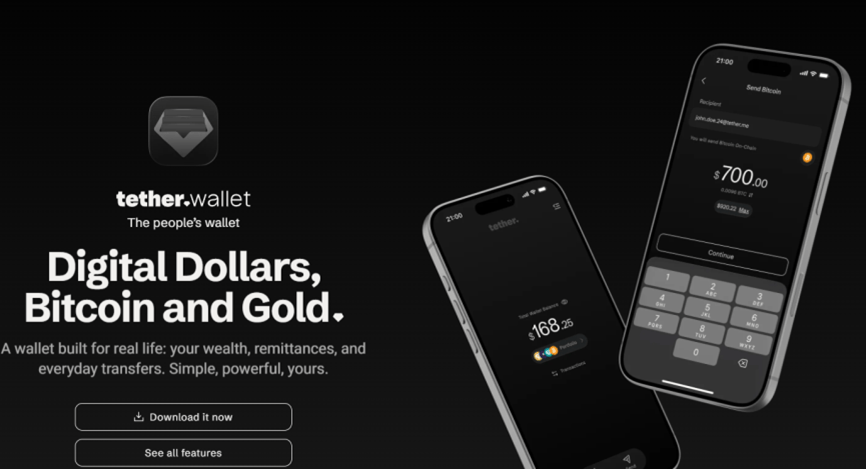
What is Tether Wallet
Tether Wallet is an official tool focused primarily on basic actions with Tether assets: storing, sending, receiving, and transaction control. It does not aspire to be a universal crypto supermarket. It is not like universal crypto wallets that combine all possible functions at once — DeFi, NFT, trading scenarios, and dozens of additional modules. In essence, the logic here is much simpler and even stricter. This restraint is both its strength and its limitation.
Interface and first impressions
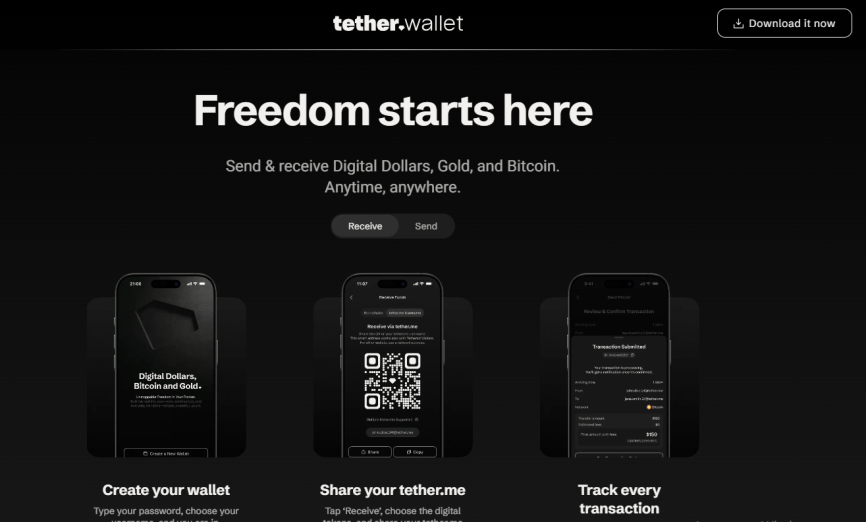
At first acquaintance, in the Tether Wallet app we see a strict working tool: the interface looks quite restrained, there are no bright elements, pop-up hints at every step, explanations, and training for new users. The interface is rather simple, nothing extra: balance, send, receive. It looks neat and functional, while not trying to teach the user. For those who have already worked with crypto wallets, this approach is usually even more convenient: nothing extra just gets in the way. But for a beginner, such directness may seem dry, questions may arise because of the lack of explanations and hints, and the first interaction with the wallet may cause difficulties.
Main features
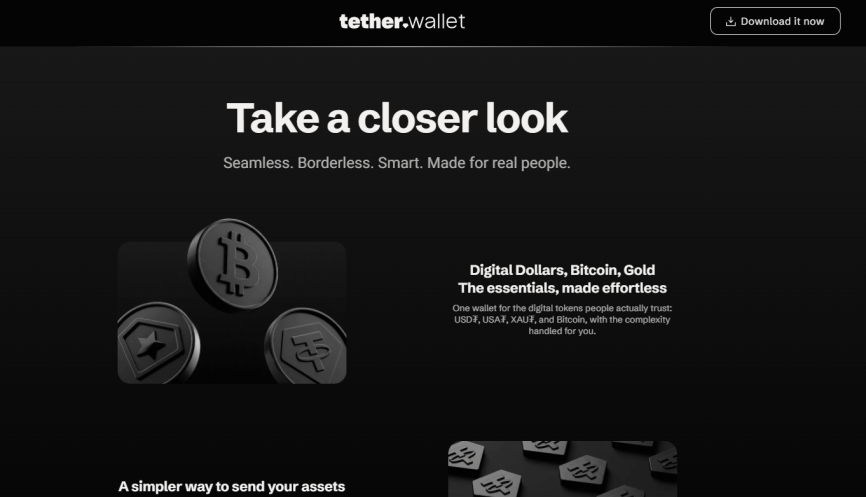
The wallet has rather basic functionality: you can store assets, send funds (USDT), receive transfers, and view transaction history. And that is where the list of functions essentially ends. If we talk about the everyday user experience, it can be noted that Tether Wallet does not try to simplify absolutely everything: the user chooses the needed action themselves and is responsible for understanding the basic logic of transferring funds. There is no visual guidance, scenario-based prompts, or detailed explanations of each step. On the one hand, this speeds up work. But on the other hand, it increases the demands on the user's attentiveness, responsibility, and experience.
The wallet functionality is basic and predictable, which is more than enough for part of the audience. Especially if the wallet is needed as a direct tool for managing a specific asset. However, compared with other modern crypto wallets that include built-in exchanges, additional payment scenarios, and extended services, such a set of functions looks quite limited. That is why Tether Wallet is better assessed by asking, "for what task was it created?" Then it can be said with confidence that Tether Wallet - is about an official and understandable environment for basic work with Tether assets, as well as direct access and practical simplicity.
Using convenient username addresses instead of long crypto addresses
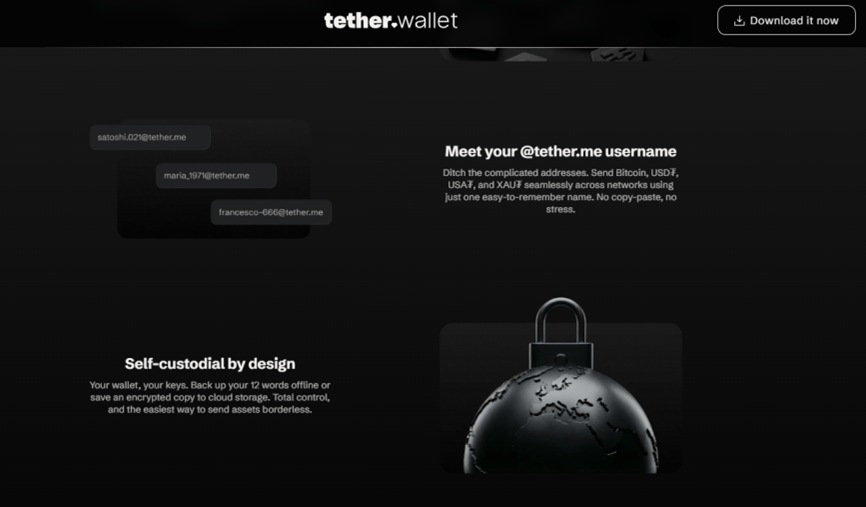
For cryptocurrency wallets, the question of control over assets is fundamentally important, because along with the interface the user also chooses the model of interaction with funds. When interacting, it is important to understand the very principle of asset management. In the case of Tether Wallet, the user is fully responsible for access to their funds and operations; the emphasis shifts toward more direct and independent work with assets. There are no hints when sending, no explanations of fees, and no warnings.
It can be noted that it is often the storage model that determines how convenient or complex a wallet is to use.
Mobile wallet interface and main user actions
Security and control
Tether Wallet is closer to a non-custodial model, where the user not only uses the service, but also takes responsibility for access and for carrying out transactions. The user controls it, manages access to funds, and interacts with them directly. This means that responsibility for keeping access secure lies entirely with the user. At the same time, the wallet is designed to be used as efficiently as possible by removing some functions.
Custodial and non-custodial wallets: what is the difference and what should you choose
Here it makes sense to move on to comparing custodial and non-custodial solutions. In practice, this comparison is very important. For some users, control will be the deciding factor, while for others it will be the convenience of daily use and the availability of additional services.
Non-custodial wallet is usually chosen by those who value being able to directly control their assets, independently manage access to assets, and not depend on an extended service infrastructure, those who need a tool for basic operations without additional services, as well as those who see the wallet as a solution for basic tasks: storing Tether assets, sending them, receiving them, and tracking transactions without unnecessary layers. In this sense, Tether Wallet is a typical example of a non-custodial wallet for storing and transferring funds.
Custodial solutions are built on a different logic and scenario. In real life, when users regularly use cryptocurrency, there is a demand for convenience and additional features in everyday wallet use. Here, what matters to the user is not only the fact of storing funds, but also the overall comfort of working with them. The provider takes on part of the service and infrastructure load, and the wallet becomes part of the financial environment. Such solutions are more convenient in everyday scenarios. For example, Cropty Wallet offers an extended set of features: use for regular payments, working with different networks, for crypto lending and yield deposits, which is simpler and clearer for beginners, and also preferable for regular use.
Thus, it makes sense to compare Tether Wallet with Cropty Wallet.
Cropty is a custodial format, which means it focuses not only on storage and transfers, but also on convenience in everyday use. This approach is relevant when the user needs not only basic operations, but also additional features such as crypto lending services, recurring payment scenarios and everyday spending, yield deposits. In other words, Cropty Wallet is focused not only on preserving the asset, but also on the broader practice of using it.
The official Tether Wallet is more suitable for those who need a simple working tool for basic operations with USDT without extra services and conveniences for storing and transferring, as well as direct management of Tether assets. Cropty Wallet offers broader functionality: additional services, simplified operations, and flexibility when working with assets, which makes it a more universal and convenient solution for regular use. It will be closer to users who are looking for convenience and a more comfortable service environment, plan to use cryptocurrency regularly, and count on additional services within a single wallet.
Therefore, the choice of wallet depends on how exactly the user plans to use the wallet. Neither of these approaches can be called the best and most universal: much depends on exactly what the user expects from the wallet in real life.
Advantages and disadvantages of Tether Wallet
The wallet has its own strengths and weaknesses.
The strengths of the wallet include its clear focus, simple interface, and the absence of unnecessary functions and elements in the interface. It does not overload the user with secondary features. For an experienced user, this is convenient: the interface is relatively clean, and the logic of actions is clear. In addition, the official status of the solution is a factor of trust, and may be perceived positively by those who prefer to work within a branded ecosystem.
The weaknesses of this wallet include a limited set of functions, a small number of features, weak support for beginners, and an interface that looks strict compared with modern solutions. The interface cannot be called complicated, but it also does not look friendly to a new audience. This is not a critical drawback, but rather a feature of the wallet itself.
Who is this wallet suitable for
The Tether Wallet is best suited for users who are already familiar with basic crypto logic and want to use a simple official tool for working with Tether (USDT) assets, and do not need a large number of additional services. It is appropriate if the priority is storage, transfers, and a clear transaction structure.
But this wallet may not be suitable for a user who plans to actively use cryptocurrency in everyday life, work with different tools and networks, and for whom convenient conversion between networks and practical services are important. In that case, custodial solutions like Cropty Wallet may be more practical.
Summary
In the end, Tether Wallet cannot be called a universal wallet or a modern multifunctional application. Rather, it is a specialized tool with a clear purpose and a fairly straightforward logic of use. For some users, this will be its main advantage: nothing extra, an official format, basic operations at hand. For others, it will be a limitation, especially if broad functionality is needed. That is why the choice of such a product depends not on the number of features, but on your own use case. If direct access to assets and a simple tool are needed, then Tether Wallet will handle this task. If flexible work with cryptocurrency, convenience, and additional capabilities are important, then it is worth considering the custodial Cropty Wallet.