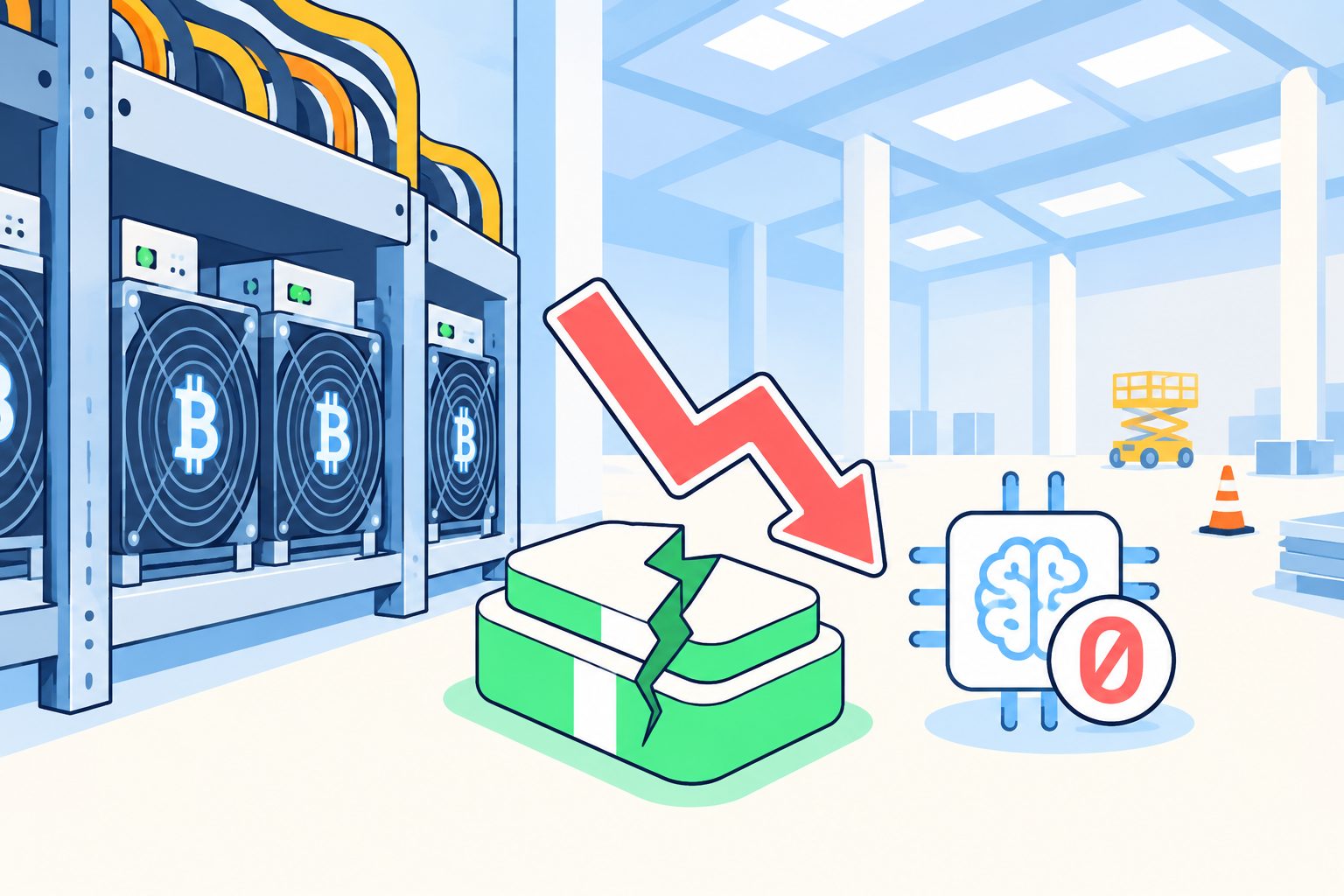
CleanSpark reported a $987.1 million consolidated net loss for the fiscal year ended September 30, 2026, while its Bitcoin mining business generated $576.5 million in revenue. Its Data Center Infrastructure segment recorded no revenue or profit as the company continued developing its AI and high-performance computing business.
The company has a 20-year lease agreement for its Sandersville, Georgia, site, but construction is ongoing and lease revenue has not begun.
Mining revenue fell 25% year over year. CleanSpark had reported $364.5 million in net income in FY2025. In the fourth quarter of FY2026, revenue declined 46% to $120.9 million, while the company recorded $9.8 million in net income.
The annual loss included $281.6 million in Bitcoin fair-value losses, $118.7 million in losses on Bitcoin-collateralized receivables and $177.1 million in impairment charges. The impairments included $168.1 million related to the planned Sandersville conversion and write-downs of less-efficient mining machines. Depreciation and amortization totaled $428.2 million, and operating activities used $468.4 million in cash.
The Data Center Infrastructure segment covers development, leasing and hosting for AI and high-performance computing workloads. CleanSpark reported no segment revenue, material expenses, profit or loss for the year, and described the business as being in its startup phase. Its filing identifies one global tenant for Sandersville but does not name it. The company expects tenant-improvement revenue in FY2027 and lease commencement fees beginning in November 2027, within FY2028.
The Sandersville agreement covers 175 MW of critical IT load for 20 years, with two five-year extension options. CleanSpark estimates about $6.56 billion in lease payments over the initial term, excluding extensions and variable real-estate cost reimbursements. That amount is scheduled over the contract term, not revenue already collected. The first data hall is targeted for November 2027, with phased delivery potentially continuing through March 2028; these are company projections. CleanSpark also plans to wind down mining at the site in FY2028, while Bitcoin mining continues there in the interim.
A subsidiary issued $2.276 billion in senior secured notes at 7.875%, maturing in 2031. CleanSpark says the proceeds will fund remaining project costs, repay certain prior equity contributions and fund debt-service reserves, and describes the project as fully financed.
In Texas, the company cites up to 885 MW of potential data-center capacity: 285 MW in Austin County, 300 MW in Brazoria County and another 300 MW of possible expansion. The filing says none is leased to a customer or ready to generate revenue. CleanSpark said 585 MW received conditional ERCOT Batch Zero baseload classification—285 MW at Sealy and 300 MW in Brazoria Phase 1—while the remaining 300 MW in Brazoria has a conditional studied-load classification. Both classifications remain subject to the Texas interconnection process.
CleanSpark filed its Form 10-K with the SEC on November 24, 2026. The filing places the company’s operations and assets in the United States.