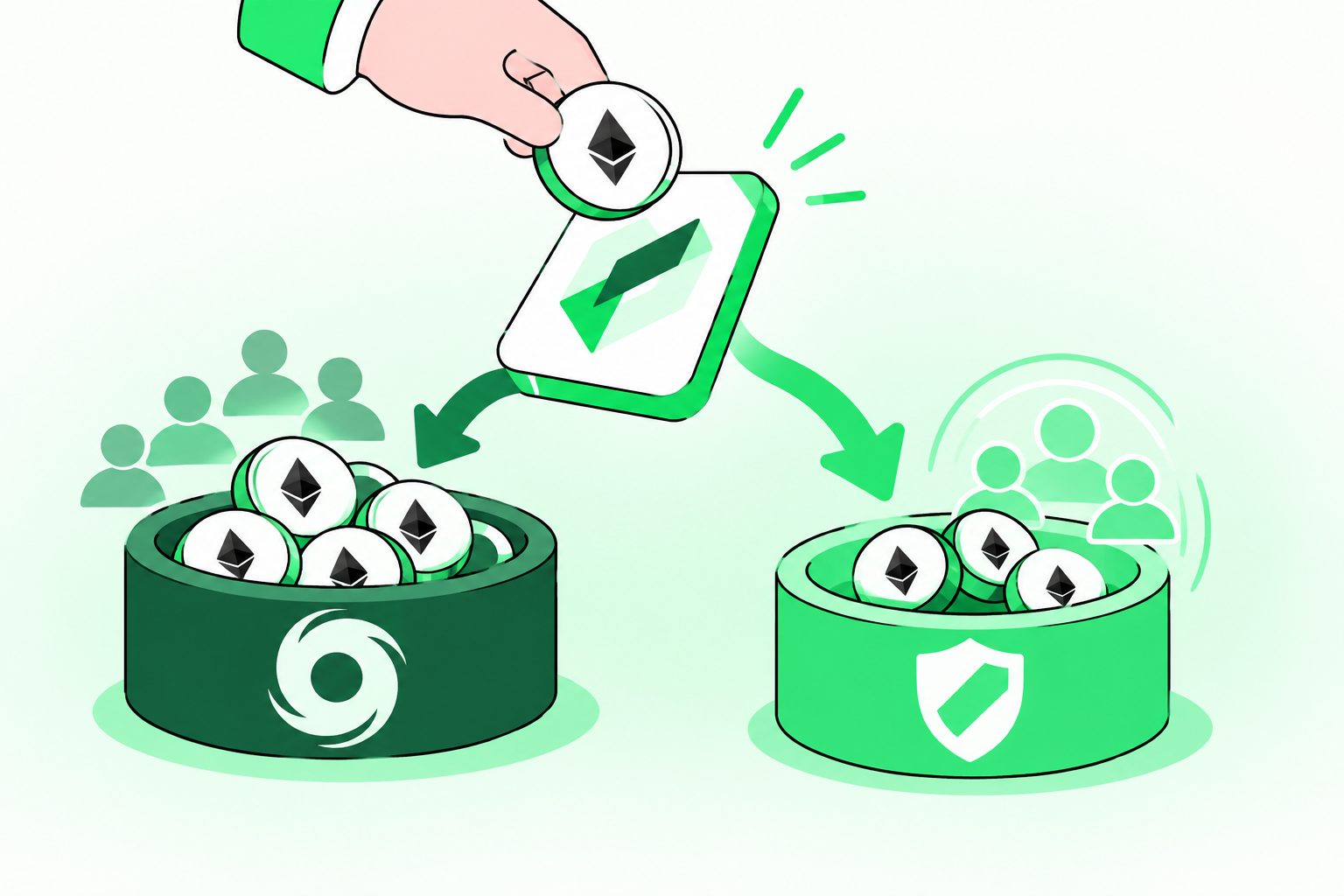
Tacit’s new tacit.wei app divides ETH deposits between Tornado Cash’s fixed-denomination pools and Tacit’s own shielded pool. The single-transaction process sends matching chunks to Tornado and the remainder to Tacit, giving users access to Tornado’s larger anonymity set while Tacit’s pool grows.
Tacit Pay powers the app. On withdrawals, Tacit’s relay submits the transaction by default, so users do not need to fund a fresh address from a potentially traceable wallet; users can also relay transactions themselves. A Nov. 23 update added private token swaps. The app warns users if fewer than 20 deposits followed their Tornado deposit, since withdrawing too soon can weaken privacy.
Tornado Cash held about $566 million in TVL, according to DefiLlama. Ethereum Foundation Kohaku privacy-wallet toolkit developer Kassandra said she was “a huge fan of the design” and noted that the app was built using Kohaku’s SDK. Its interface is served from contract code and can be reached through gateways such as tacit.wei.limo, though users still depend on Tacit’s default relay and the Z DAO, which controls the app’s name and endpoints. The approach is harder to take offline than a conventional website; Tornado’s main site went dark after U.S. sanctions in 2022, while its contracts continued operating.
Tacit began as a project focused on confidential DeFi on Bitcoin and has expanded to Ethereum and other EVM chains. Its TAC token climbed from about $0.16 to nearly $1.46 in the two days after launch, then eased to around $0.95 by Nov. 25—still more than four times higher over the week.
The project also opened a public key ceremony for Praxis, which it calls “smart contracts for Bitcoin with no fork.” Inspired by research co-authored by Stanford’s David Tse, Praxis uses witness encryption: a secret can be unlocked by proof that a specified condition was met. This could let someone spend a locked Bitcoin key with an ordinary signature, potentially enabling custodian-free bridges without changing Bitcoin. Praxis requires a trusted setup whose shared key remains safe if at least one participant discards their secret randomness. The ceremony extends a setup from Succinct, the team behind the SP1 proving system; participants can contribute randomness in a browser for up to 5 TAC.
Tacit’s releases remain experimental. TAC trades thinly, and the projects had received AI security reviews, according to the account of their development.