



Play-to-earn — a gaming model in which a user can receive rewards for actively participating in the gameplay. Depending on the game, the conditions for earning income may vary, but the essence is always the same: the more you play — the more you earn.
In the TON ecosystem, Play-to-Earn games have become widespread thanks to integration with Telegram, a low barrier to entry, and the use of Toncoin as the base economic asset.
Why Toncoin became the leading player in the Play-to-Earn market
Unlike traditional Web3 games, where users have to install separate apps, create a wallet, acquire tokens, and navigate complex mechanics, everything is much simpler in the TON ecosystem.
Many P2E games in the TON ecosystem run directly inside Telegram. This has significantly lowered the barrier to entry for newcomers and allows users to get acquainted with cryptocurrencies without installing separate apps.
There is one more important point that sets TON apart from other play-to-earn projects: the network's high performance.
TON was designed with the scale of the Telegram audience in mind. It uses a model called sharding (dividing the load into segments). This helps process a large number of transactions in parallel.
Even if a player doesn't perform transactions every minute, the various mechanics implemented in P2E games still create a heavy load. For example, in such games a user will often claim rewards, receive currency airdrops, withdraw funds, swap tokens, and so on. This is why network performance is a very important aspect.
Key distinguishing elements of P2E in TON
When people talk about Play-to-Earn in general, they most often think of how this mechanic is implemented in large projects like Ethereum, BNB Chain, or Solana. P2E in the TON ecosystem is implemented differently.
Telegram mini-apps as the basis for P2E on TON
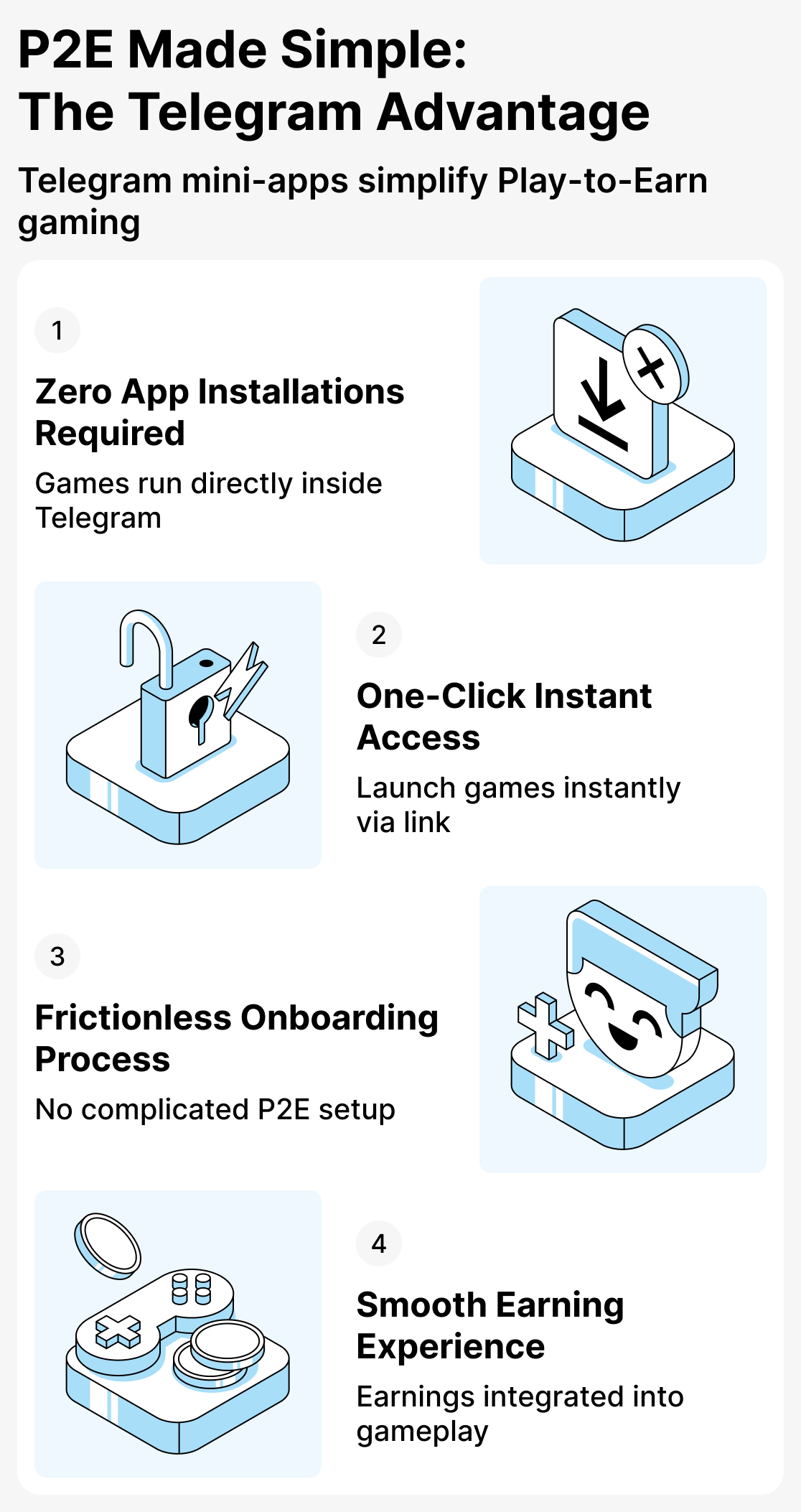
The main advantage of play to earn in TON is that games are launched inside the messenger's overlay: Telegram mini-apps.
P2E game in the TON ecosystem:
- does not require installing a separate application;
- runs inside Telegram;
- looks like a bot or an embedded web application.
For the user, this significantly simplifies the onboarding process. In a typical P2E project on another blockchain you have to install the game separately, register and connect a wallet; in games within the TON ecosystem the user only needs to follow a link to the game or launch it via Telegram mini-apps.
Often a player initially doesn't even know that it's possible to earn in the game. Sometimes they only realize this when they see an option to withdraw currency from the game.
Availability of a mass audience
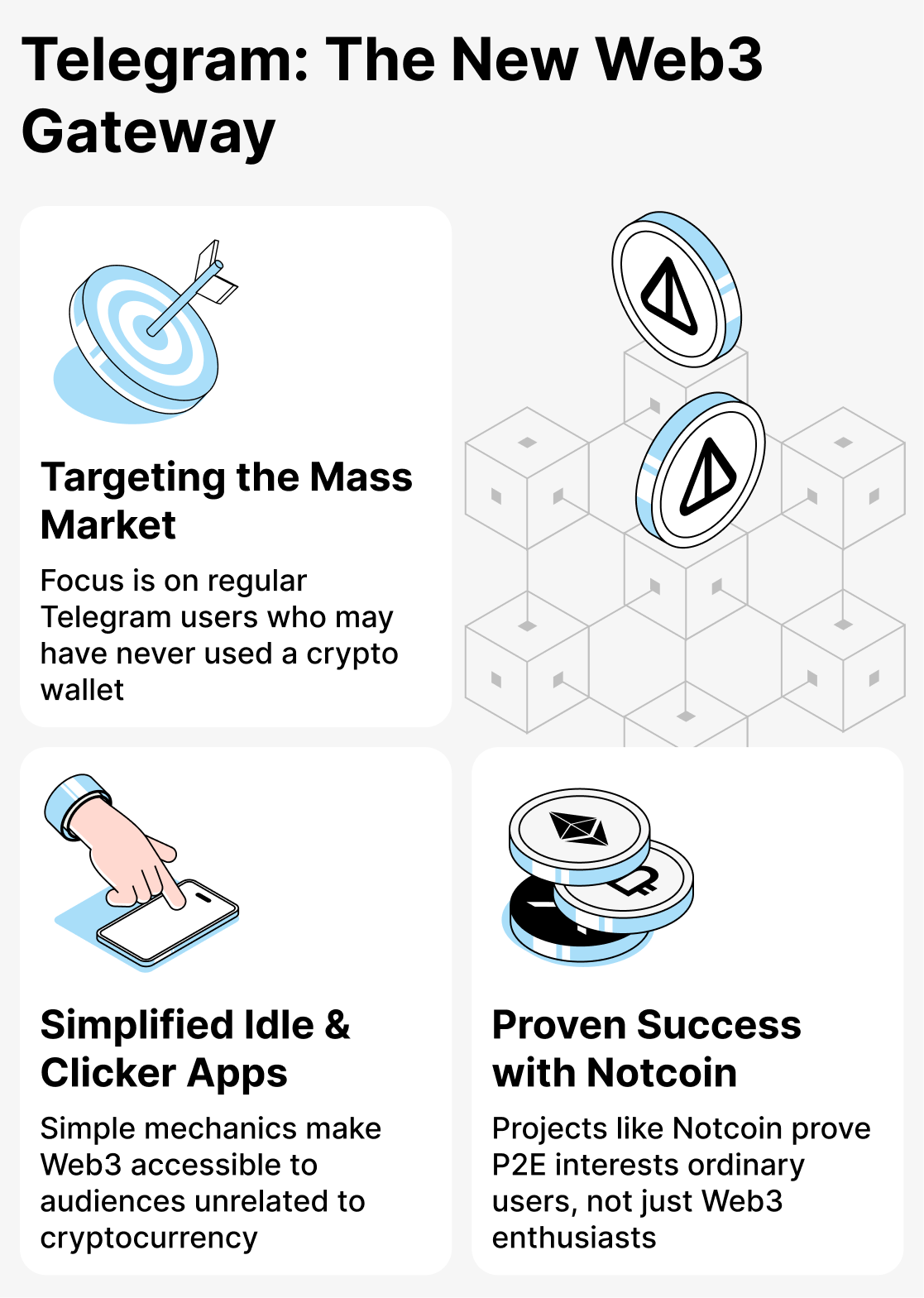
Most P2E projects target an already existing crypto audience. TON's developers, however, focus on ordinary Telegram users who might not even know what cryptocurrency is and have never used wallets.
That's why idle games and clickers have become very popular within TON. They are very well suited to a mass audience that, in general, has no connection to cryptocurrency.
For example, projects like Notcoin have shown by their success that P2E can be interesting not only for Web3 enthusiasts, but also for regular users.
Fast onboarding to crypto through a game
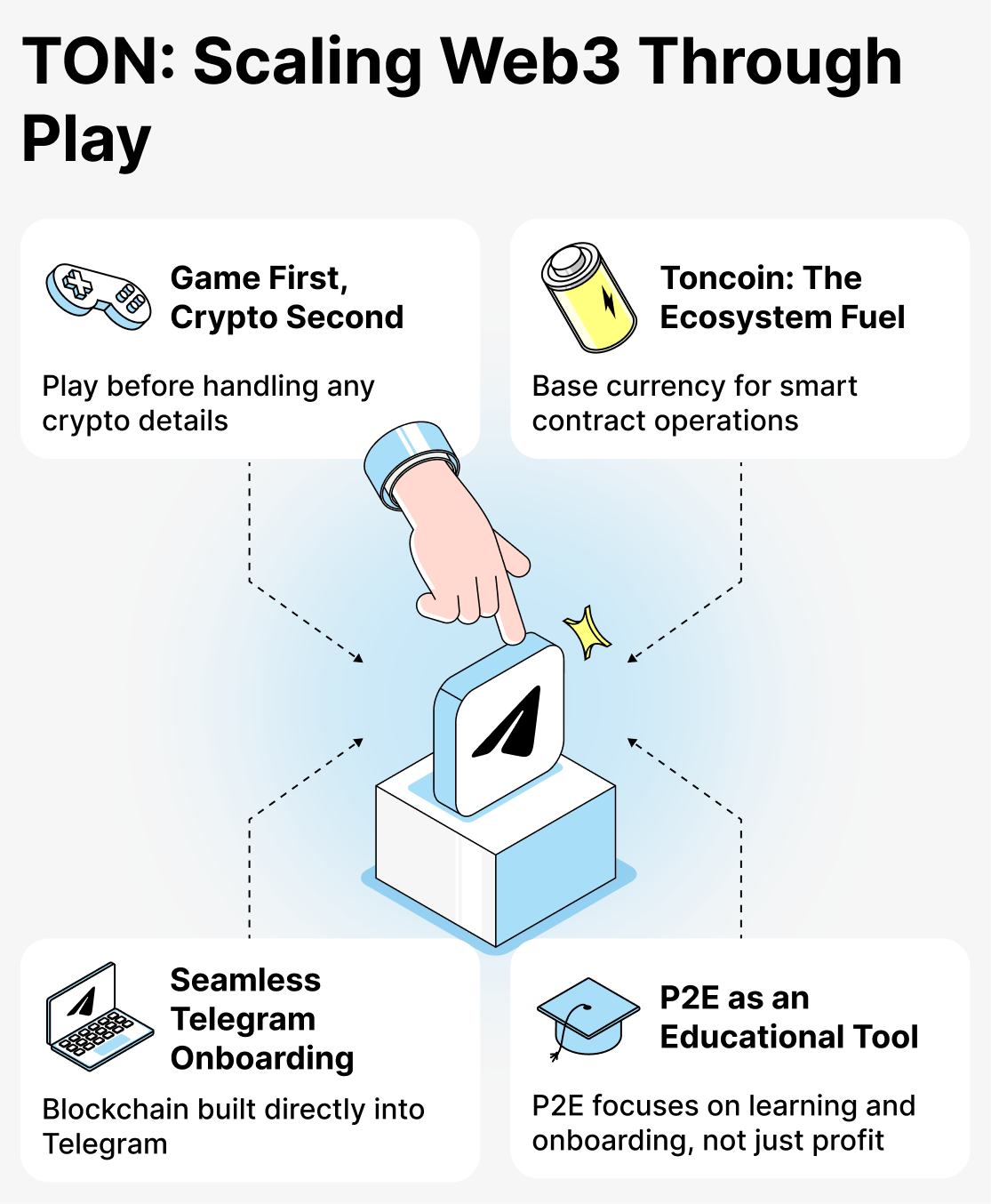
Another important feature of P2E in the TON ecosystem is that games help ordinary users gradually become familiar with cryptocurrency. In other words, games often lack complex mechanics and cluttered interfaces.
Usually, a user's immersion into the world of decentralized finance looks like this:
- The user simply starts playing the game;
- As you progress, the game will prompt you to link a TON wallet.
- The user creates a wallet directly in Telegram or connects Tonkeeper;
- After the player links their wallet, they can exchange in-game currency for Toncoin.
Ultimately the game becomes an entry point into Web3 rather than a way to make money. This approach differs significantly from classic P2E models, where the wallet and the blockchain are the foundation from the outset.
The economy is built on player attention
In many P2E projects on other networks, the emphasis is on complex economic systems. That is, you will often see a wide variety of NFT characters or other NFT items, a large in-game marketplace, and so on. In games within TON, a different model is more commonly used.
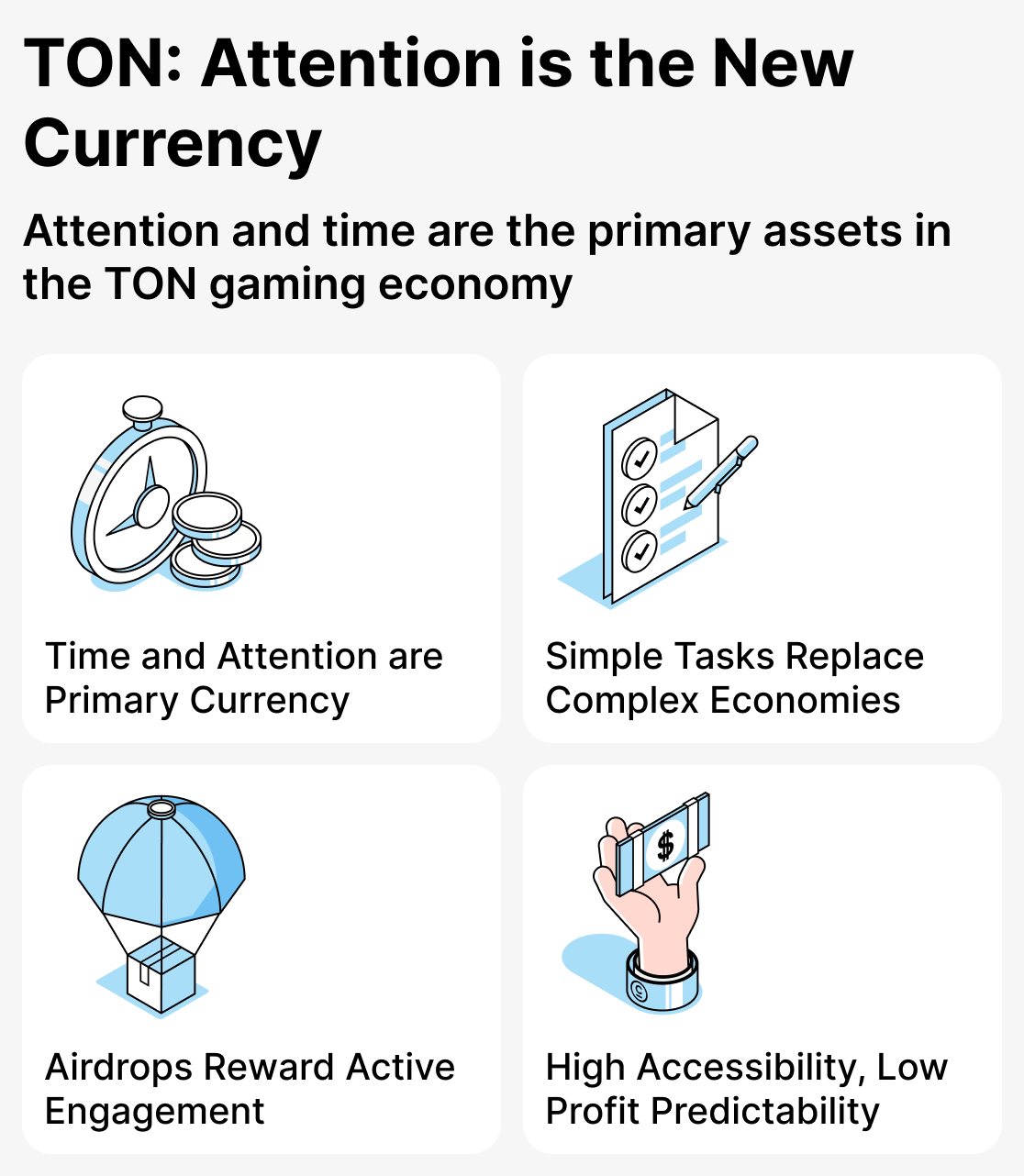
The main currency here is the player's attention and time — that is, the user is rewarded not for active investing and trading, but for their engagement and activity; often, currency in games within the TON ecosystem can be earned by completing simple tasks. Also, many P2E projects, such as X Empire and MemeFi Coin, give their users airdrops (allowing users to receive cryptocurrency for a certain period of time).
All of this makes games simpler, but at the same time less predictable in terms of returns.
TON as a platform for mass Web3 onboarding through P2E and gamification
Thus, TON became not just a blockchain with play-to-earn mechanics, but a platform for bringing ordinary users en masse into the world of cryptocurrencies. Here Toncoin serves as the bridge between games, the Telegram messenger, and the entire Web3 infrastructure.
Unlike traditional blockchain games aimed at a niche audience, TON offers a model in which the game itself is primary and crypto is secondary. The user first interacts with the game's interface inside a messenger, and only afterwards, if they wish, connects a wallet and begins to withdraw in-game currency. This approach allows millions of people to experience interacting with a blockchain for the first time without having to deal with complex technical details.
Toncoin performs several key functions simultaneously in this system.
- it serves as the ecosystem's base currency;
- TON is used to pay for transactions, interact with smart contracts, and access other Web3 services within the ecosystem.
Ultimately, P2E in TON functions less as a source of income and more as a mechanism for onboarding and education.
Implementation of NFTs in games on TON
An NFT is a digital asset in itself. It's a kind of in-game item that can be sold to another player for cryptocurrency.
Games in the TON ecosystem that use NFTs are not very common, but there have been more of them recently.
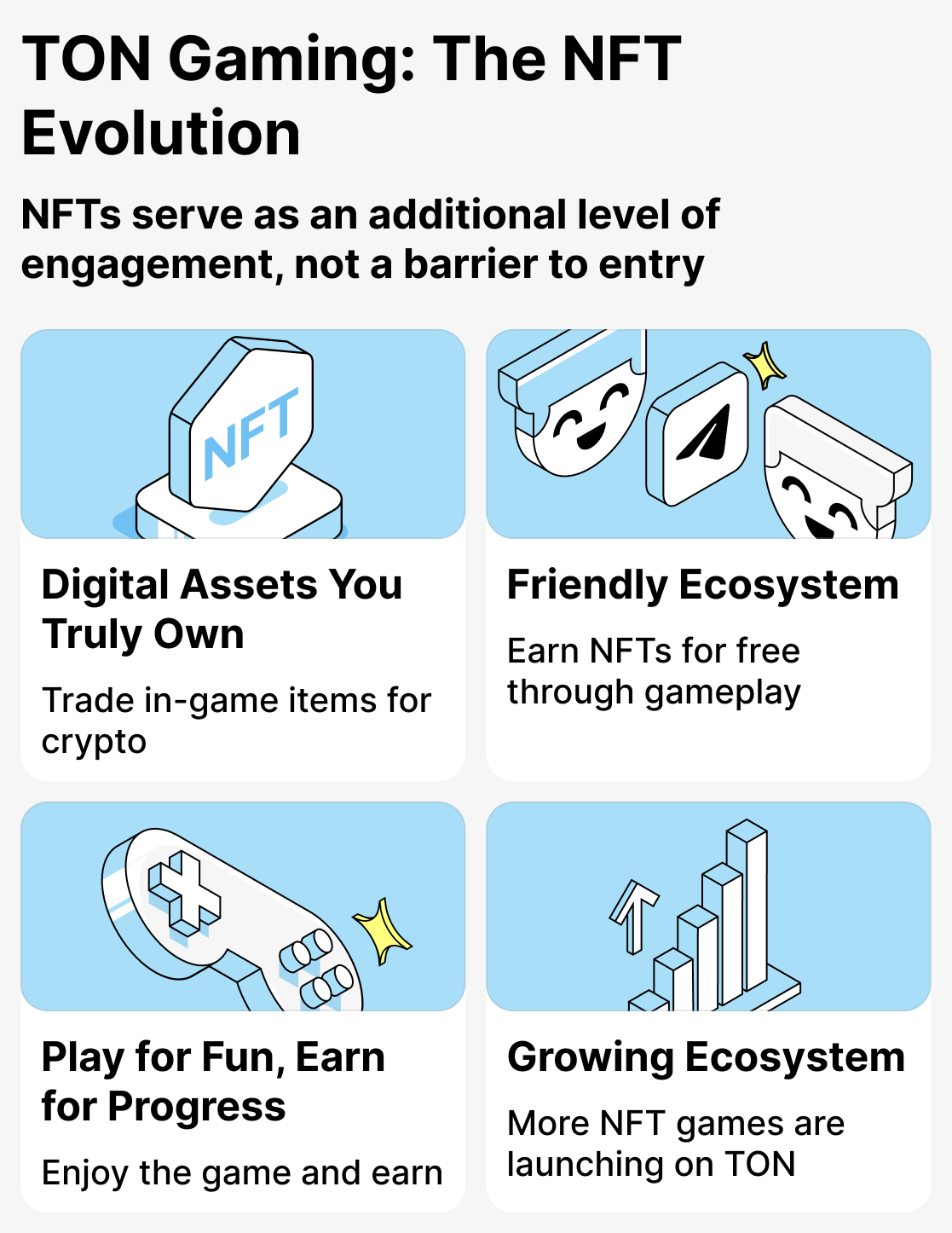
A key difference in TON's approach to NFTs is that players can interact with NFTs more easily. A user can obtain an NFT for free or earn one through in-game activity. This makes the model more beginner-friendly.
That is, a user can initially just play an engaging game without any opportunity to earn anything. However, if they enjoy the game and spend a lot of time progressing in it, there is a chance to receive an NFT and then use it to make a profit.
Thus, NFTs in games within TON are not a mandatory element, but an additional layer of engagement.
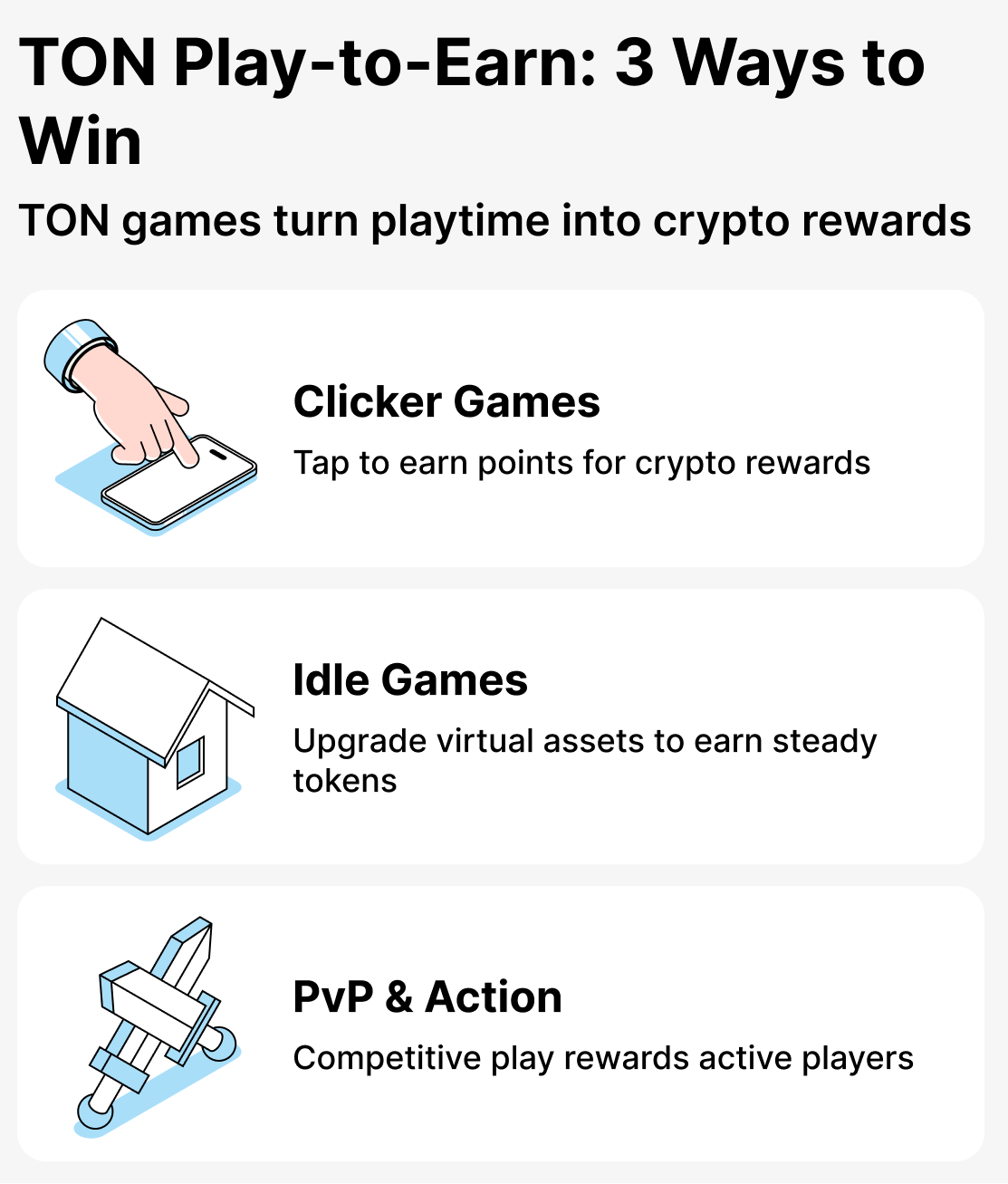
Main types of P2E games in the TON ecosystem: clicker games, idle games and PvP/action projects
Play-to-Earn in the TON ecosystem offers a wide variety. Mostly these are games with simple gameplay, but this is what allowed P2E projects to quickly expand beyond the crypto community and attract a mainstream audience.
Let's look at the most common formats.
Clicker games
Tap-to-earn — the most recognizable P2E mechanic used in the TON ecosystem. Its essence is extremely simple: the user performs basic actions (taps the screen) and earns in-game points or tokens that can then be converted into Toncoin.
Projects like Notcoin and X Empire have shown that a clicker game can become an entry point into the world of digital assets for tens of millions of users. The main requirement is a clear and fair distribution of rewards at the end of the season.
In most such games you can't withdraw the currency immediately. Players often accumulate points, raise their rating or level up their account, and receive the cryptocurrency at the end of the season.
Tap-to-earn uses an attention distribution mechanism. Players spend their time playing the game, the project achieves wide reach and active audience growth, and Toncoin or related tokens serve as the ultimate form of value.
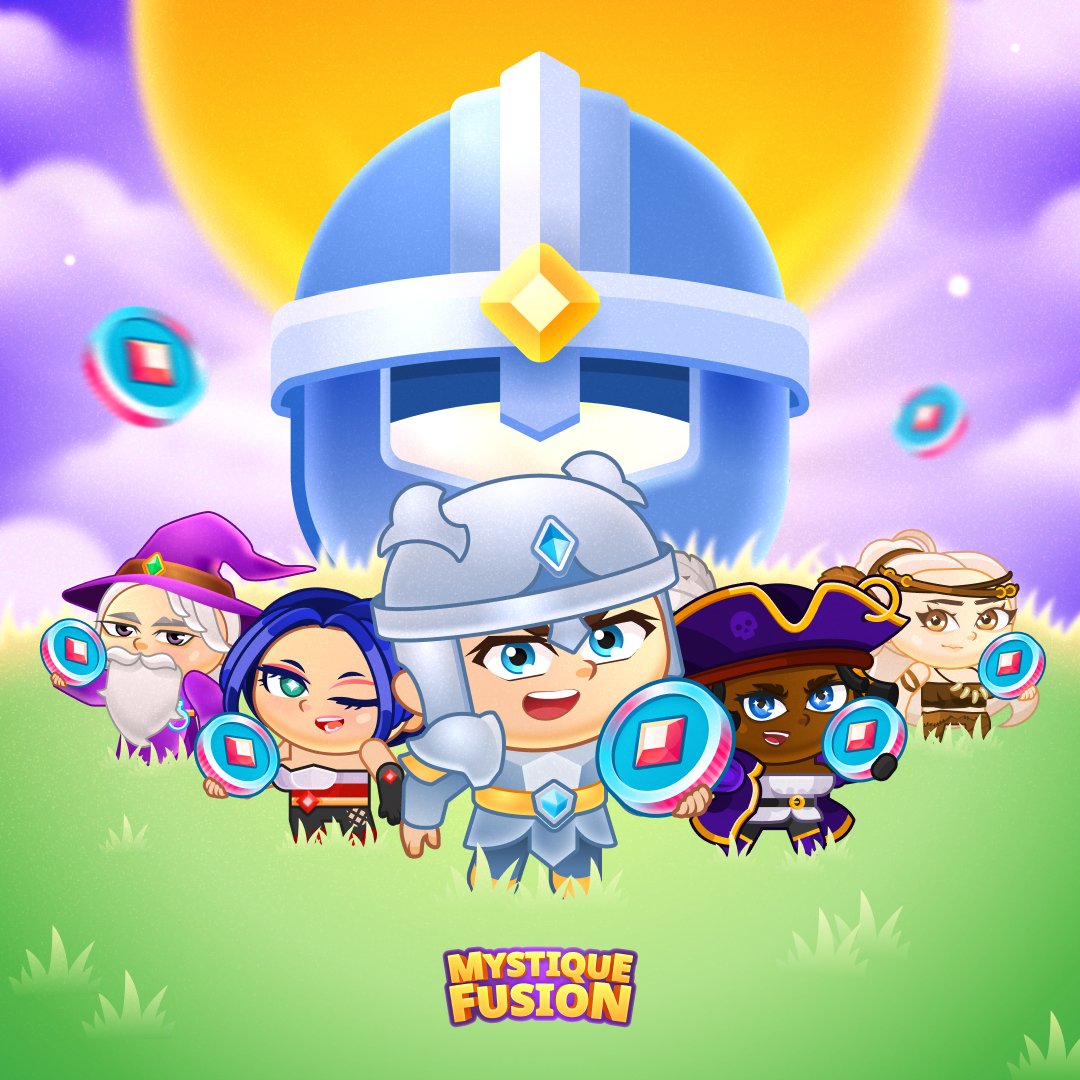
Overall, there are many clicker games, but truly worthwhile projects that deliver on their promises can be counted on one hand. One such project is the game Mystique Fusion. Here you can not only earn a bit of money, but even build your own business and reach a whole new level! You can download the game completely free on any device from the App store or Google Play.
Idle games
In such games the player builds and develops their own world (a base, a farm, etc.). Here they must build and upgrade sources of income (mines, plantations), improve the character's attributes, and increase the base's productivity.
A good example of a game that implements this mechanic is Catizen. Here players collect and level up virtual cats that over time begin to generate income.
Unlike clicker games, idle games allow users to set up a system for earning passive income.
Important detail: in most TON projects, a player's earnings are paid not in Toncoin but in the game's internal token. After that, the user can convert the currency into cryptocurrency or use it to progress within the project.
PvP and action-games in the TON ecosystem
In addition to clicker and idle games, a distinct segment of PvP and action games is gradually taking shape in the TON ecosystem. These are projects where the main emphasis is not on accumulating resources but on direct interaction between players.
Unlike classic P2E games on other blockchains, the PvP format on TON is largely casual. This is a deliberate choice by many developers. After all, games need to work well inside Telegram and be understandable to a wide audience.
In such games, rewards are more often tied to a specific result or the player's ranking, which makes the PvP format more competitive compared to clickers and idle games.
A good example of an action game in the TON ecosystem is PixelTap.
Overall, PvP and action games play an important role—they expand the P2E genre diversity within the ecosystem.
Popular P2E games in the TON ecosystem
Catizen
In Catizen, players raise virtual pets and care for them. Eventually the pets begin to generate income in the form of in-game currency. The higher a pet's level, the more income it generates. The in-game currency can be converted into the project's token, CATI, which can then be exchanged for TON.
PixelTap
PixelTap — is a fighting game that differs significantly from traditional clickers. Players compete against each other and upgrade their fighters. For victories and various in-game actions, users earn in-game currency that can be converted into PIXFI and then exchanged for Toncoin.
MemeFi Coin
MemeFi Coin — is a classic clicker game set in a world of crypto memes. Each meme appears as a boss that the community fights together to earn rewards. During these battles, users accumulate in-game tokens — MEMEFI — which can be converted into TON.
P2E economy in the TON ecosystem: seasons, airdrops and the role of Toncoin as the ultimate asset
In P2E projects of the TON ecosystem, the key role is played not so much by the gameplay itself as by the value-distribution model. Unlike classic games of this type, where crypto can be withdrawn immediately, most TON projects use a seasonal economy.
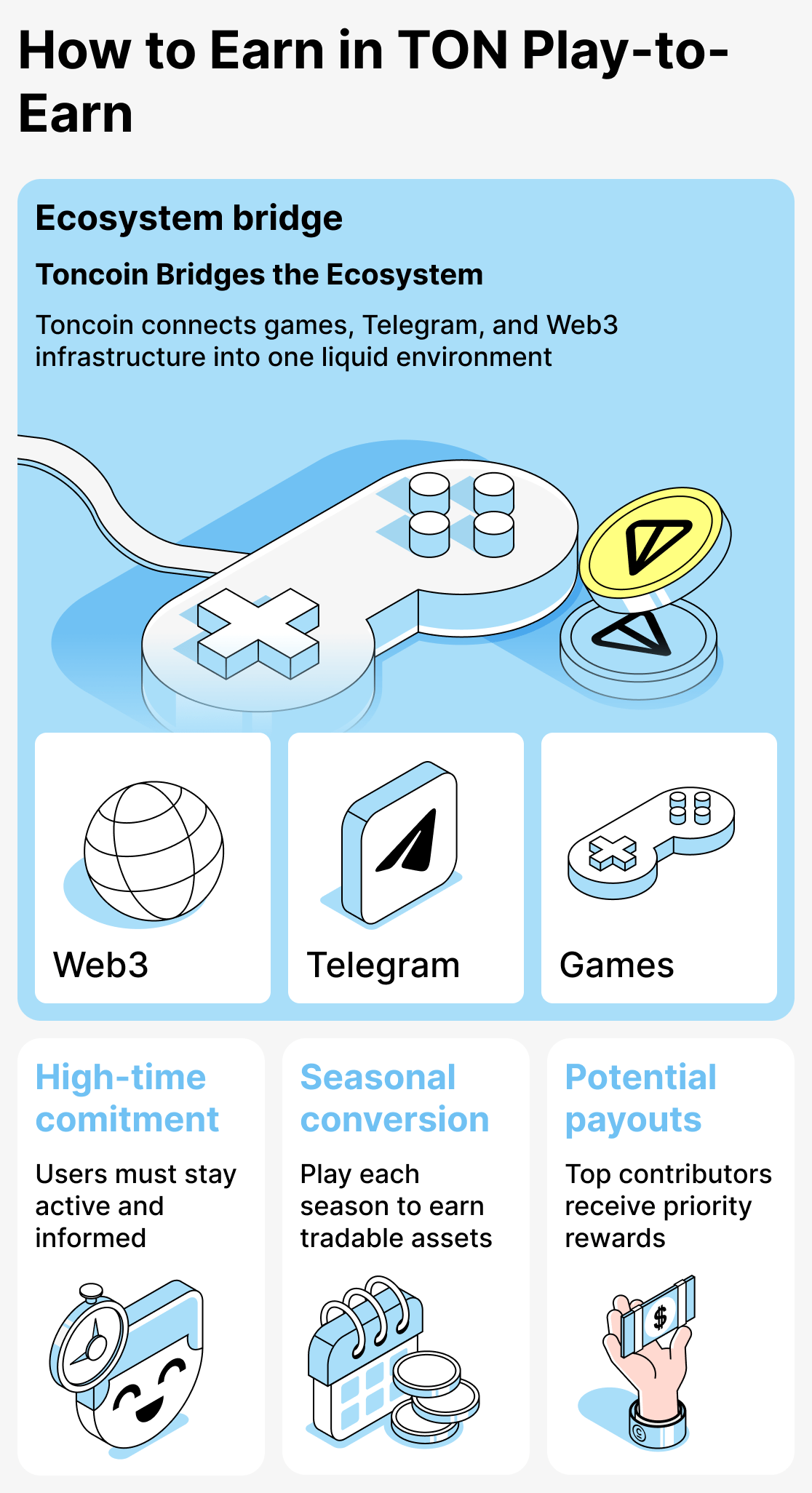
In this way, in-game progress and activity are converted into real value only at the project's final stage. The main element of this model is Toncoin.
Seasonal model as the basis for TON's P2E economy
Most P2E projects in the TON ecosystem are organized by seasons. A season is a time-limited period during which the user plays, completes tasks, earns points, and increases their “weight” among others.
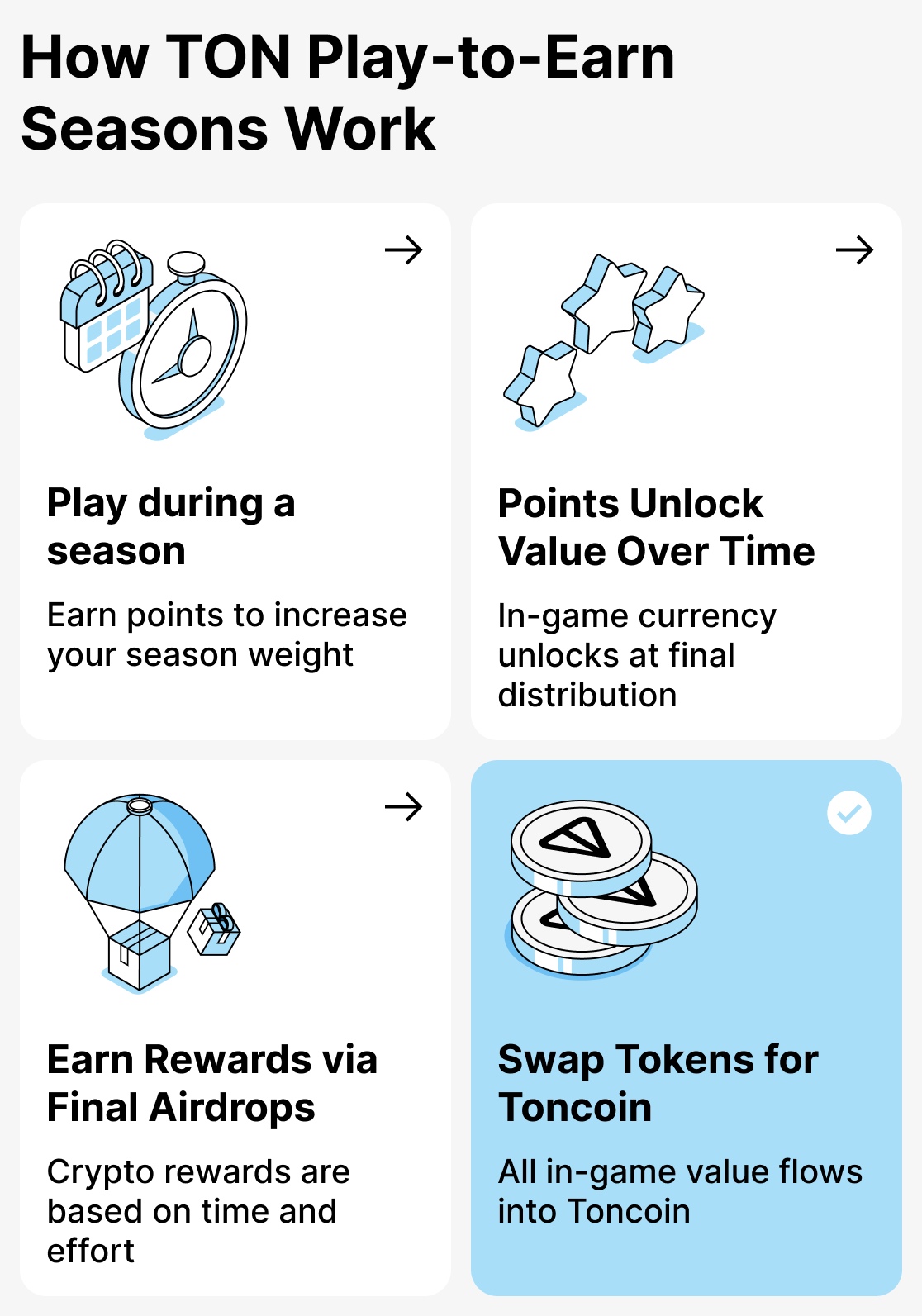
The value of in-game currency is symbolic. Points and in-game tokens generally have no market price until the end of the season. This allows projects to scale their audience without budget loss and to properly manage distribution rules.
From the user's perspective, the seasonal model shifts a player's focus from the idea of making instant profit to a more realistic one: at the end of the season there's a chance to receive money.
Airdrops as a mechanism for distributing value
An airdrop is the distribution of cryptocurrency to players at the end of a season. In other words, the developers assess each participant's contribution and reward them based on how far the player managed to progress.
In most cases, airdrops do not guarantee that a player will receive a reward. It all depends on how much effort and time the user has actually invested in developing the project.
Seasonal airdrops are typically distributed once — at the final stage of the season or game cycle.
How are game tokens connected to Toncoin
The key feature of TON's P2E economy is the use of a multi-stage model of value distribution. That is, such games have their own in-game currencies or tokens that players earn during gameplay. Then, either these tokens are tallied by developers and converted into crypto which is issued to players as an airdrop, or the game includes a model to exchange tokens for Toncoin.
Tokens can also be used in the game itself for development and leveling up.
Toncoin in such games serves as the final settlement unit into which game activity can be converted. Even if TON is not used directly in the game, it is present as a source of liquidity and as a gateway to the real crypto economy.
How to earn in P2E games within the TON ecosystem
The P2E economy in TON is built around seasons, airdrops, and the gradual conversion of in-game activity into a liquid asset. Toncoin here serves as the connecting link, tying together games, the Telegram messenger, and Web3 infrastructure. It is precisely thanks to this model that P2E projects in TON can grow and develop actively for years without going bankrupt.
Thus, to earn by playing play-to-earn games within the TON ecosystem, you need to spend a lot of time in the project, actively progress, and keep up with all the news. There is no guarantee you will receive anything, but if your contribution is truly significant, the developers will appreciate it and may reward you.
Summary: the role of P2E in the TON ecosystem and the importance of Toncoin
Play-to-Earn in the TON ecosystem is not just a way to monetize, but a full-fledged model for mass onboarding of users into the crypto space. Unlike classic Web3 games aimed at a narrow audience, TON focuses on simplicity and accessibility for everyone.
Clicker games, idle games and NFT projects on TON reward players not for their investments, but for their attention. The economy of most such projects is built around seasonal distribution of cryptocurrency, with Toncoin serving as the final unit of settlement and the bridge between gameplay and Web3 infrastructure.
It's important to understand that P2E in TON does not guarantee a stable income. However, by playing such games you can get acquainted with cryptocurrency, spend time enjoyably, and, with a certain probability, earn your first money using digital assets.